2G, 3G, 4G and 5G Towers – Requirements and Differences
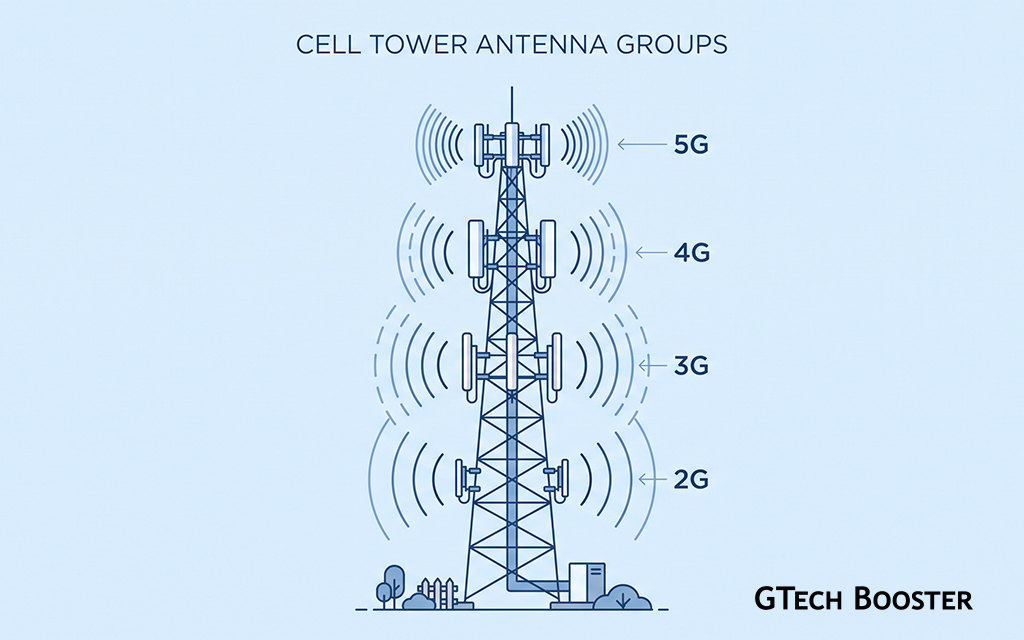
A cell tower is only the support structure, the mast, pole, or rooftop frame that holds antennas high above the ground.

When people talk about a network “upgrading from 3G to 4G” or “rolling out 5G,” it is easy to picture engineers building a brand new tower for each generation. That is rarely what happens. The tall steel structure is often the same one that has stood on the hill for twenty years. What changes is what is attached to it, what is connected underneath it, how many of them are needed, and how much they cost to run. This article explains what each mobile generation asks of a tower site, how the generations differ, and why 5G in particular changes the economics of covering an area.
First, What Is a Tower and What Is a Site
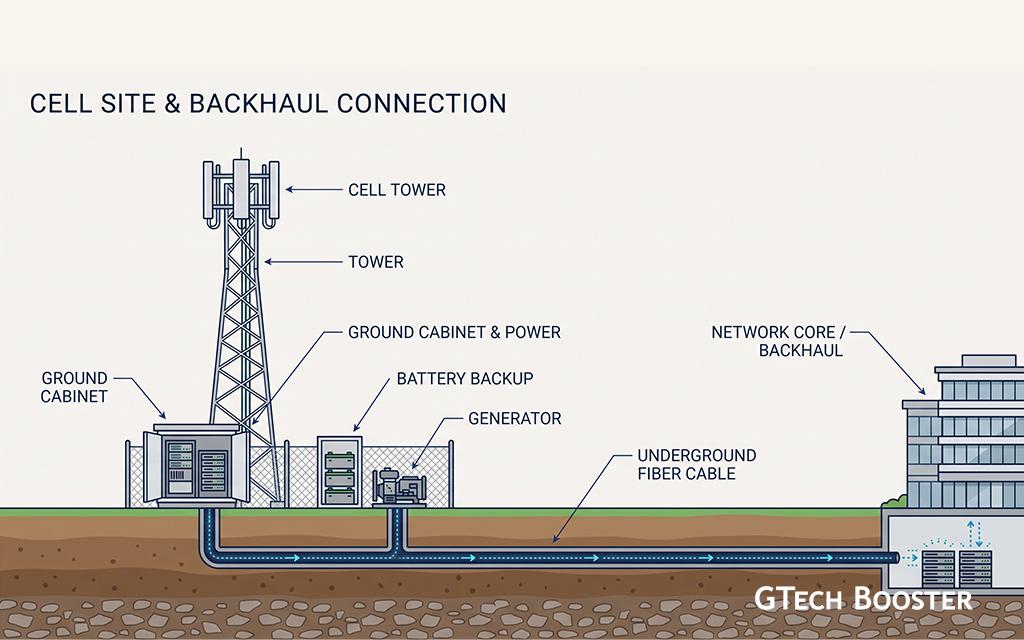
A cell tower is only the support structure, the mast, pole, or rooftop frame that holds antennas high above the ground. The communication itself is done by the equipment mounted on and around it. Together, the structure, antennas, radio equipment, power supply, and connection to the wider network make up a cell site.
Keeping this distinction clear makes the rest easy to follow. The structure is mostly generation neutral. The antennas, radios, spectrum, power, and network links are generation specific. A single tower commonly hosts equipment for several generations at once, and for several operators too.
The Parts of a Cell Site
Every site has the same broad building blocks, whatever the generation. Antennas send and receive radio signals, usually arranged in three sectors that each cover about one third of the surrounding circle. Radio equipment converts signals between the radio form used in the air and the digital form used in the network. A power system, typically mains electricity with batteries and often a generator, keeps the site running. A backhaul link carries traffic from the site to the operator’s core network, using fiber, a microwave radio link, or sometimes satellite. Finally there are cabinets, cooling, grounding, lightning protection, and security.
Why Generations Differ at All
Each generation is a different way of sharing radio spectrum among many users and of moving data through the network. The radio waves themselves obey the same physics in every generation. Lower frequencies travel farther and pass through walls better. Higher frequencies carry more data but fade quickly and are blocked more easily. Each new generation tends to use more spectrum, more advanced antennas, and more efficient techniques to squeeze out higher speeds and capacity. That is why the tower requirements grow as the generations advance.
2G: The Voice and Text Foundation
Second generation networks, built mainly on GSM, brought digital voice and SMS. They introduced many things people now take for granted, including USSD sessions, which still run on 2G signaling.
Equipment
The 2G radio base station is called a BTS, short for base transceiver station. Several BTS units are managed by a base station controller (BSC), which handles tasks such as handing a call from one cell to the next. The air interface divides users by frequency and time slot, so each call occupies a small slice of the channel.
What a 2G Site Needs
The equipment is relatively small and light, the power draw is modest, and backhaul needs are low because the traffic is mostly voice and small amounts of data. Early backhaul used leased copper circuits or microwave links carrying a limited number of calls. Because 2G commonly uses lower frequency bands, one tower covers a wide area, which is why 2G reaches remote places cheaply and is still kept alive for coverage and for services such as mobile money menus.
What 2G Cannot Do Well
Data on 2G, through GPRS and EDGE, is slow, measured in tens to a few hundred kilobits per second, which is enough for text and basic messaging but not modern web pages or video.
3G: Mobile Internet Arrives
Third generation networks, built mainly on UMTS and its HSPA upgrades, made mobile internet practical for ordinary users.
Equipment
The 3G radio base station is called a Node B, controlled by a radio network controller (RNC). Together they form the 3G radio access network. The air interface uses wideband code division, in which users share the same wide channel and are separated by codes.
What a 3G Site Needs
A 3G site needs wider channels than 2G, more capable radio units, and noticeably more backhaul because internet traffic is far heavier than voice. Operators moved from older circuit links toward packet based backhaul, with fiber or higher capacity microwave links at busier sites. Many 3G networks used spectrum that covers less distance than the lower 2G bands, so extra sites were sometimes needed to match 2G coverage, especially indoors.
4G: A Simpler, All Internet Network
Fourth generation networks, based on LTE, were designed from the start for data and treat voice as just another internet service.
Equipment
The 4G base station is called an eNodeB. A key change is that it combines the radio functions of the Node B with much of the control that a separate RNC did in 3G, so there is no separate radio controller. The downlink uses OFDMA, which splits the channel into many narrow subcarriers, and the network core is entirely packet based.
What a 4G Site Needs
Because the eNodeB handles more on its own and users stream video and run apps, 4G sites need strong, low delay backhaul, and fiber becomes the preferred option, with high capacity microwave as an alternative. Antennas are more advanced, with multiple transmit and receive elements known as MIMO, which increases speed without more spectrum. Operators also combine several frequency bands, called carrier aggregation. A single 4G site often carries equipment for multiple bands, so the antennas and cabling on the tower grow more crowded.
5G: More Capacity and More Sites
Fifth generation networks use a new radio standard called 5G NR, and the base station is called a gNB.
Equipment
The gNB connects 5G devices to the network. In a standalone 5G deployment it works with a new 5G core. In a non standalone deployment it works alongside a 4G core and relies on the 4G network for control, which lets operators launch 5G on top of existing networks. The 5G radio can use much wider channels, and many modern deployments use advanced antennas with large numbers of elements, called massive MIMO, to steer narrow beams toward individual users. Operators also commonly split base station functions into separate units so some processing can be centralized, though sources I consulted did not cover that in detail.
Three Types of 5G Spectrum
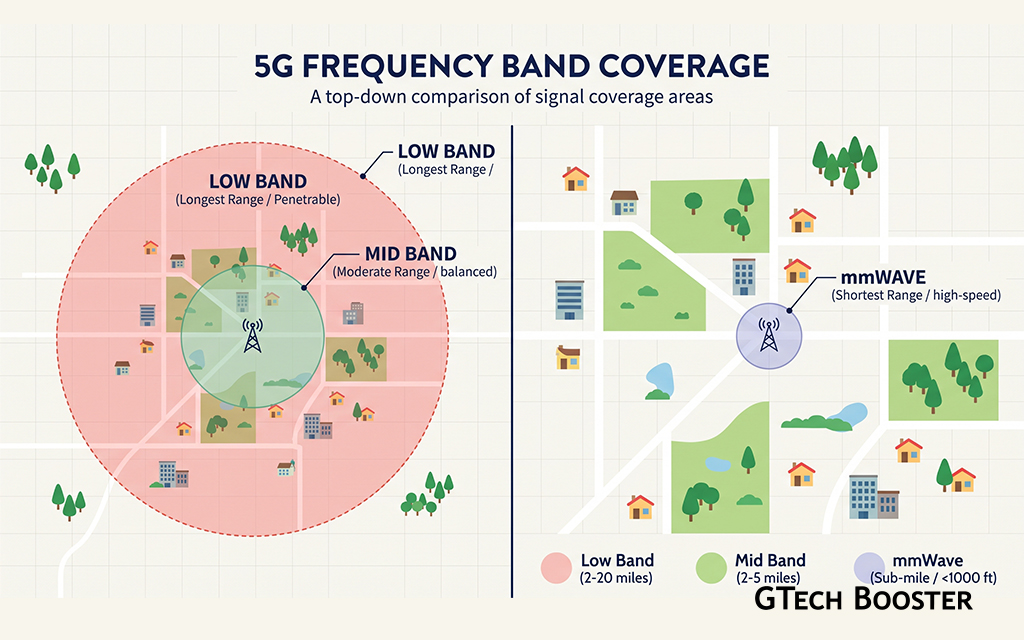
The most useful way to understand 5G site requirements is by spectrum, because frequency decides range. One consumer guide gives the following approximate figures, which vary with terrain and conditions.
| 5G band | Typical frequency | Approximate range per cell | Typical speed |
|---|---|---|---|
| Low band | 600 to 900 MHz | 5 to 10 miles (about 8 to 16 km) in open terrain | 50 to 200 Mbps |
| Mid band | 2.5 to 3.7 GHz | About 1 mile (about 1.6 km) in open terrain | 200 to 700 Mbps, sometimes 1 Gbps or more |
| mmWave | 24 to 40 GHz | Roughly 500 to 1,500 feet (about 150 to 450 m) | About 1 to 4 Gbps |
Low band 5G covers wide areas with few towers but offers speeds only modestly above 4G. Mid band, where most real world 5G traffic now sits, balances coverage and speed but needs a denser grid of sites. MmWave delivers the highest speeds but needs near line of sight and covers only a short distance, so it appears mainly in dense city centers, stadiums, and airports.
What a 5G Site Needs
Because higher frequencies reach less far, covering the same area with mid band or mmWave takes more sites than covering it with 4G. In dense areas, operators add small cells, compact antennas on lampposts, building walls, and short poles that cover from a few hundred to a couple of thousand feet. Massive MIMO antennas are larger and heavier than older panels, so the tower must be checked for the extra weight and wind loading, and sometimes strengthened. Backhaul must be much faster, so fiber is strongly preferred, and many small cells need fiber run to each pole. Power demand is generally higher than for earlier generations, so batteries, cooling, and electricity supply may need upgrading.
Comparing the Generations Side by Side
The table below sums up the main differences. Speeds are rough typical ranges for each technology, not guarantees.
| Generation | Radio node | Controller | Main technique | Typical backhaul | Typical uses |
|---|---|---|---|---|---|
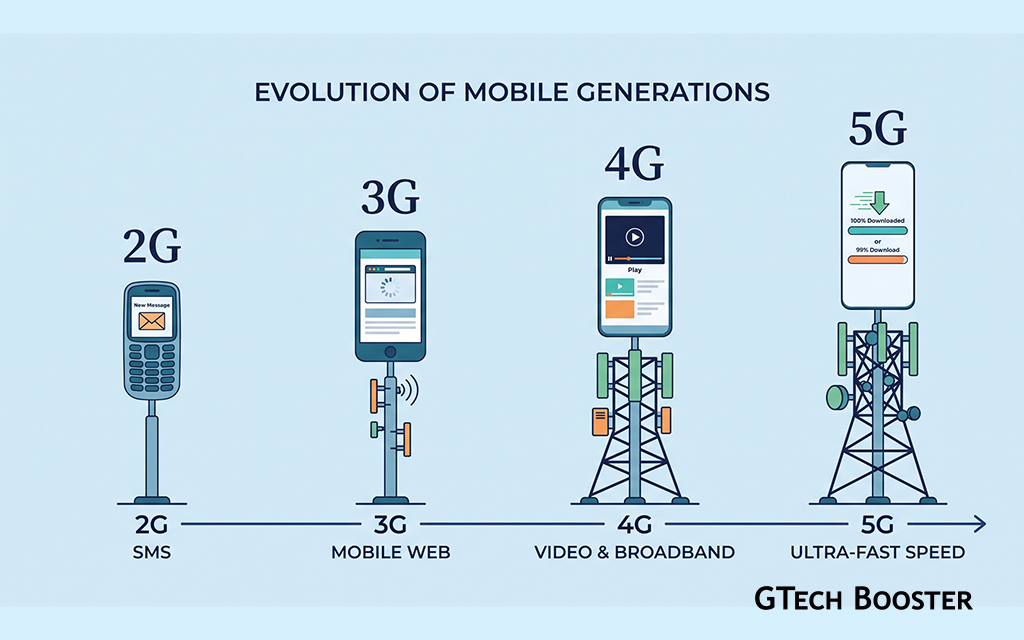
| 2G | BTS | BSC | Frequency and time slots | Copper or low capacity microwave | Voice, SMS, USSD, basic data |
| 3G | Node B | RNC | Wideband code division | Packet links, microwave, some fiber | Mobile web, email, basic video |
| 4G | eNodeB | None separate | OFDMA with MIMO | Fiber or high capacity microwave | Video streaming, apps, voice over internet |
| 5G | gNB | Functions redistributed | New radio, massive MIMO, beamforming | Fiber strongly preferred | Very high speed, dense areas, new services |
Site Density and Coverage Trade Offs
Because of how frequency affects range, the number of sites needed rises as networks use higher frequencies for more capacity. One guide puts typical spacing at roughly 0.3 to 1 mile in urban areas, 1 to 3 miles in suburban areas, and 3 to 10 miles or more in rural areas, with outdoor ranges of about 3 to 10 miles for low band 4G and 5G and only 500 to 2,000 feet for mmWave. These are rough figures that depend on terrain, antenna height, and traffic load.
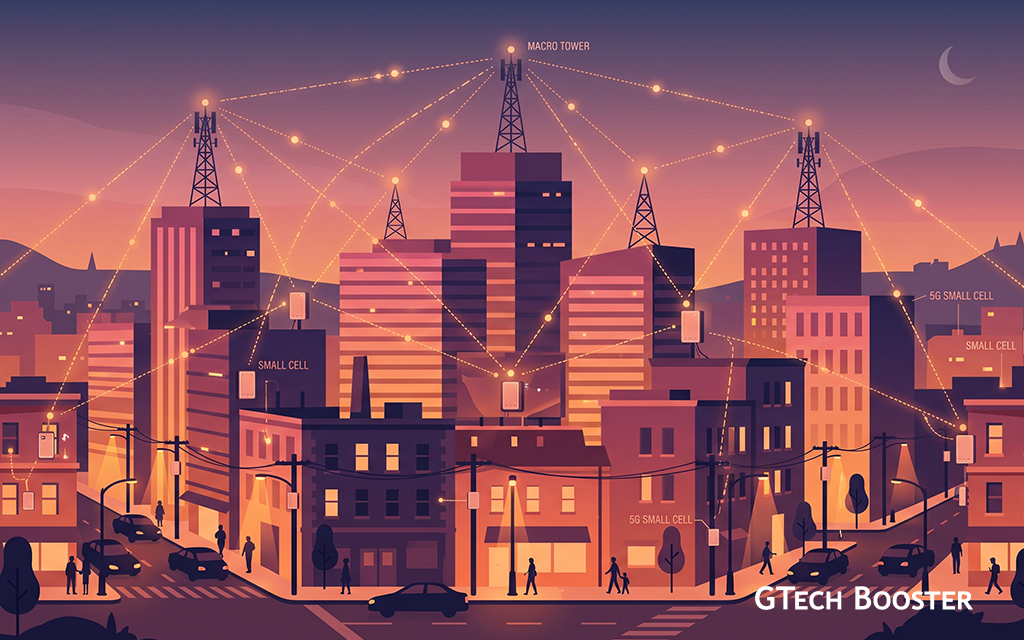
The result is a practical split. Rural areas lean on low band spectrum and on older generations, where one tall tower can cover a large area. Cities add more sites and small cells to supply capacity.
Retiring Old Generations
Operators cannot simply turn off old networks, because many phones and devices still depend on them. Some phase out 3G first to reuse its spectrum for 4G and 5G, while others keep 2G for coverage and for basic services. Modern radios can often support several generations on the same hardware, which makes upgrades easier, but older generation equipment still has to be powered, maintained, and backhauled until it is retired.
Bringing It All Together
The tower itself changes little from one generation to the next. What changes is the equipment on it and under it. 2G needs small, low power equipment with light backhaul and covers wide areas. 3G adds wider channels and heavier data traffic. 4G moves to an all internet design, with more capable antennas and a strong preference for fiber. 5G adds wider spectrum, massive antennas, and, at higher frequencies, a need for many more sites, small cells, faster backhaul, and more power.
The central trade off never goes away. Lower frequencies reach far but carry less data, and higher frequencies carry more data but reach less far. Understanding that one rule explains why rural coverage still leans on older and lower band networks, why 5G looks different in a city center than on a highway, and why the tower you see on the hill is only the most visible part of a much larger system.
More Information ℹ















Conversation
Login to comment.
Log In / Register