The Source and the Shortcut – Origin Servers vs CDN Edge Servers
Engineers call it the origin. For a small site serving a few local visitors, the origin is all you need. But the moment your audience spreads across cities,
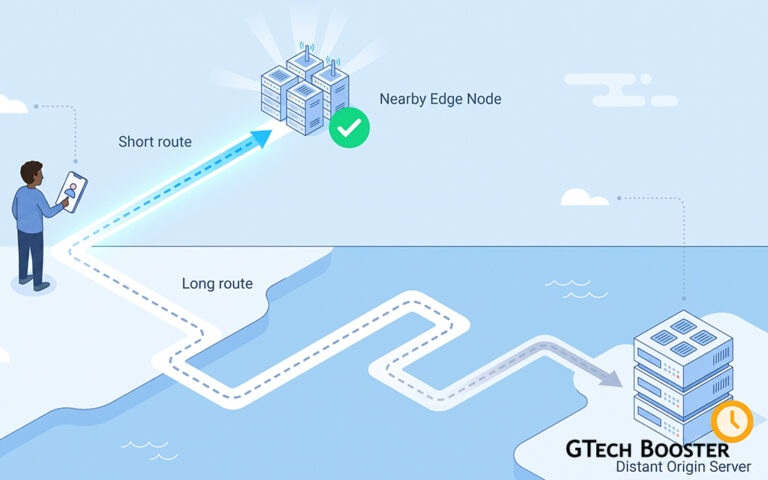
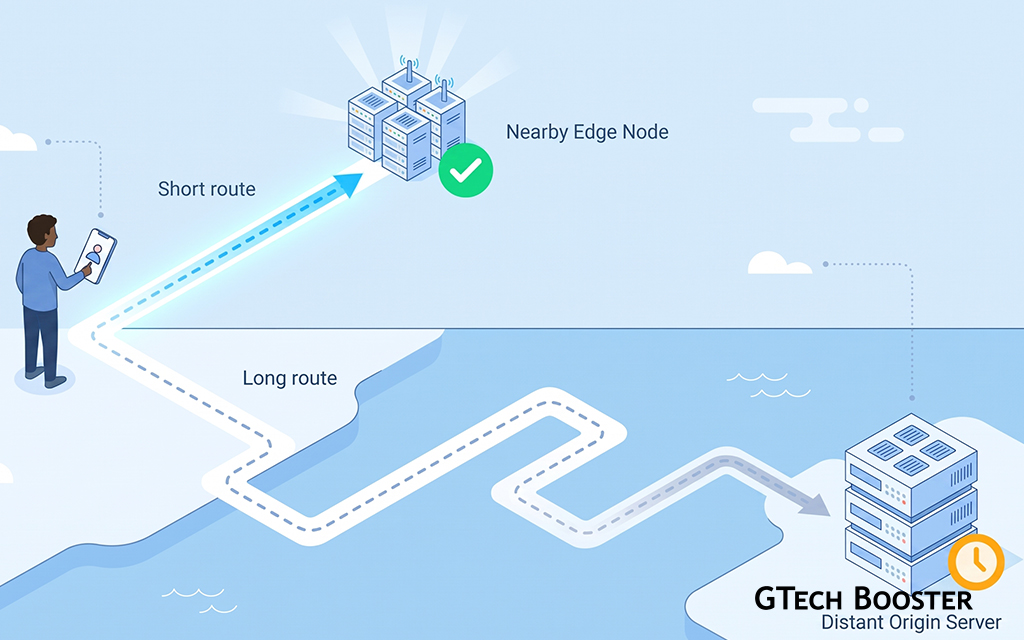
Every website has a home. It is the machine, or cluster of machines, where the pages are assembled, the database lives, and the files are stored. Engineers call it the origin. For a small site serving a few local visitors, the origin is all you need. But the moment your audience spreads across cities, countries, and continents, a problem appears that no amount of server horsepower can fix: distance. A request from Tamale to a server in Frankfurt still has to cross a lot of cable, and the speed of light is not negotiable.
The Content Delivery Network, or CDN, is the industry’s answer. It places copies of your content on edge servers close to your visitors, so most requests never travel to the origin at all. This article explains what each side does, how they cooperate, where the cooperation breaks down, and what it all means for a developer or site owner in Ghana.
Quote
The origin decides what is true. The edge decides how fast the truth arrives.
Two Roles, Not Two Competing Products
The most useful way to understand the pair is to treat them as roles in a relationship, not as rivals. Origin and edge are not alternatives you choose between. You almost always have both, and each is good at something the other is bad at.
The origin is the source of truth. It runs your application code, talks to your database, authenticates users, and produces the authoritative version of every page and file. The edge is a network of caches and light compute spread across many cities. It holds copies, answers repeat questions quickly, and shields the origin from most of the traffic. If the origin is the kitchen, the edge is a chain of serving counters stocked from it.
The Origin Server in Detail
An origin can be many things. It might be a single virtual server running WordPress, a fleet of containers behind a load balancer, an object storage bucket holding images and video, or a managed platform running a web application. What defines it is not the hardware but the responsibility: it is the place the CDN goes to when it does not already know the answer.
What Only the Origin Can Do
Some work cannot be copied and handed out. A bank balance, a shopping cart, a checkout confirmation, and a private message are different for every user and change constantly. The origin produces those, because only the origin has the live data and the logic to compute them. It also owns every write: new orders, new comments, uploads, and password changes all end at the origin, however the visitor arrived.
Why Origins Struggle Alone
Left to face the internet directly, an origin has three weaknesses. It sits in one place, so distant visitors pay a latency tax on every request. It has finite capacity, so a traffic spike from a viral post or a promotion can overwhelm it. And it is exposed, so attackers can target it directly with floods of requests. The CDN exists to fix all three.
The Edge Server in Detail
An edge server lives in a point of presence, usually shortened to PoP. A PoP is a facility, often inside an internet exchange point or a data centre, where the CDN keeps servers close to large groups of users. When someone visits your site, the CDN’s routing system directs them to a nearby PoP, using techniques such as DNS steering or anycast addressing, which lets many locations announce the same IP address so the network delivers the visitor to the closest one.
What the Edge Does
The first job is caching. The edge keeps copies of files that are safe to reuse, such as images, stylesheets, scripts, fonts, video segments, and often whole pages, and serves them without contacting the origin. The second job is connection handling. The edge terminates the visitor’s secure connection nearby, which shortens the handshake, and maintains efficient long-lived connections back to the origin. The third is protection, absorbing floods of malicious traffic across a large network so the origin never sees most of it. A growing fourth job is compute, where small programs run at the edge to rewrite requests, personalise responses, or make routing decisions without a trip home.
What Happens When a Visitor Arrives
The mechanics are easier to see as a short story. A visitor opens your site. Their request reaches the nearest edge server, which checks whether it holds a fresh copy of the requested file. Two outcomes are possible.
The Cache Hit
If the edge has a fresh copy, it returns it immediately. The origin is never contacted and the visitor gets a fast response, limited mostly by the short distance to the nearby PoP. This is the happy path, and the entire economics of a CDN depend on making it as common as possible.
The Cache Miss
If the edge has no copy, or the copy has expired, it must fetch a fresh one from the origin, return it to the visitor, and store it for the next person. The first visitor in a region pays the full cost of the trip. Everyone after benefits. A miss is not a failure, it is how the edge learns, but a site that misses constantly is a site that gains very little from its CDN.
The Number That Matters: Cache Hit Ratio
Because hits are cheap and misses are expensive, the single most telling statistic about a CDN setup is the cache hit ratio, the share of requests answered from cache. Every miss becomes a request to your origin, so a higher ratio means a quieter origin, a lower server bill, and faster pages.
One 2026 guide to origin shielding gives a worked example worth reading with care, since it is a single guide and not an independent study. In its case study of a site handling about 12 million requests a day, adding a shield raised the hit ratio from 87.4 percent to 96.1 percent and cut origin requests from roughly 1.5 million a day to about 470 thousand. The origin’s 95th percentile time to first byte improved from 340 milliseconds to 210. Treat those numbers as an illustration of the direction and rough scale of the gain, not a promise for your site.
Quote
A few percentage points of hit ratio can sound trivial. At millions of requests a day, they are the difference between a calm origin and a struggling one.
Who Controls the Cache: The Rules You Write
The edge does not decide on its own what to keep. It follows instructions, mostly supplied by your origin in HTTP response headers, and sometimes overridden by rules in the CDN’s dashboard.
Cache-Control and TTL
The Cache-Control header tells caches how long a response stays fresh, a period known as its time to live, or TTL. A header such as max-age set to a day tells the edge it may reuse the file for 24 hours without asking. A related directive, s-maxage, applies specifically to shared caches like CDNs, which lets you keep objects at the edge longer than you allow in a visitor’s browser. Short TTLs keep content fresh but send more requests to the origin. Long TTLs save work but risk showing outdated content after you make a change.
Purging and Invalidation
When you change a file before its TTL expires, you need a way to tell the edge to forget the old copy. This is called purging or invalidation, and most CDNs let you purge a single URL, a directory, or everything, through a dashboard or an API. Propagation takes seconds to minutes, so for a brief window different regions may see different versions. A common professional habit is to avoid the problem altogether by putting a version or content hash in the filename of assets, so a new release is simply a new URL.
The Cache Key
The cache key is the identity the edge uses to decide whether two requests are asking for the same thing. By default it is built from the URL, but headers and query parameters can join it. This is where hit ratios quietly die. If your site adds a unique tracking parameter to every link, or if responses vary on a header with many possible values such as User-Agent or Cookie, the CDN sees every request as new and stores a separate copy each time. The guide cited above flags broad Vary headers as one of the most common causes of poor hit ratios, noting that Vary on Accept-Encoding is generally safe because it has so few values.
The Middle Layer: Origin Shield and Tiered Caching
A CDN with hundreds of PoPs has a quirk. Each PoP is its own cache. If a file expires everywhere at once, or a purge clears it, every PoP that gets a request will independently ask your origin for the same thing. Dozens of locations can hit your server simultaneously for one file, which is exactly the load the CDN was supposed to prevent.
How a Shield Fixes It
An origin shield is an intermediate cache that sits between the edges and the origin. Edge servers that miss ask the shield first, and only the shield talks to the origin. Without a shield, each edge that misses fetches the object on its own. With one, the origin sees roughly one request per object per TTL window instead of one per edge.
Request Coalescing
Shields usually pair with request coalescing. When many requests for the same uncached object arrive at nearly the same moment, the shield sends a single request to the origin and makes the others wait for that answer, rather than letting them all through. This protects the origin from the stampede that follows a traffic spike or a purge, sometimes called a thundering herd. Coalescing only works when the CDN recognises the requests as sharing a cache key, which loops back to the point about keys above.
Single Shield or Tiered Cache
Providers implement the idea in two ways. A single shield funnels all misses through one chosen PoP, which gives excellent coalescing and suits smaller catalogues. A tiered cache arranges regional caches in layers before the origin, which adds hops but scales better for very large catalogues and worldwide audiences. The guide offers a rule of thumb of a single shield for under about a million cacheable URLs and tiered caching for ten million and above, which is a heuristic and not a law.
When a Shield Does Not Help
A shield is not free. A miss that passes through it takes an extra hop, which the guide estimates at roughly 10 to 40 milliseconds for a single shield and 15 to 60 for a tiered one. Personalised responses gain nothing, since there is nothing to share between users. Latency-sensitive API calls that cannot be cached can be hurt by the extra step. And for a small site with a high edge hit ratio and modest traffic, the same guide suggests a shield is usually unnecessary.
Origin and Edge Side by Side
The differences are easier to scan than to hold in your head, so the table below summarises the two roles. The categories are general principles that hold across most providers, though details vary by vendor.
| Aspect | Origin server | CDN edge server |
|---|---|---|
| Role | Source of truth for content and logic | Nearby cache and delivery point |
| Location | One place, or a few regions | Many cities, often hundreds of PoPs |
| Best at | Dynamic, personalised, write operations | Static files, repeat reads, absorbing spikes |
| Latency for distant users | High, grows with distance | Low, since content is served nearby |
| Failure risk | Overload and direct attack | Misconfigured caching, stale content |
| Cost driver | Compute, database, and bandwidth out | Per gigabyte delivered and per request |
| Who sets the rules | You, through application code | You, through headers and CDN configuration |
What the Edge Does for Security and Resilience
Speed gets the headlines, but many teams adopt a CDN mainly for protection. Because visitors connect to the edge and not to your server, the origin’s real address can be kept private. Large CDN networks absorb volumetric attacks across their capacity, and many offer firewall rules and bot filtering at the edge, before bad traffic gets near your application. This only works if you lock the door behind it: if your origin still accepts connections from anywhere, an attacker who discovers its address can bypass the CDN entirely. The sensible practice is to configure the origin to accept traffic only from the CDN’s published ranges or through a private tunnel.
When the Origin Goes Down
Edges can also soften an outage. If a file is cached and fresh, visitors keep getting it even while the origin is offline. Many CDNs support serving stale content while the origin recovers, or revalidating in the background, using directives such as stale-while-revalidate and stale-if-error. How long this keeps a site usable depends on the content. A brochure site may look unaffected for hours. A site built on logins and carts will fail on the first request that has to reach home.
Static, Dynamic, and the Blurry Middle
The old rule said a CDN is for static files and the origin is for dynamic pages. Reality has moved on. Many pages that look dynamic are the same for every visitor over a short window, such as a news front page or a product listing, and can be cached for even 30 or 60 seconds. At scale, that brief window turns a thousand origin requests into one.
The edge now also runs code. Edge compute platforms let you execute functions in the same PoPs that serve your files, handling redirects, A/B tests, authentication checks, and personalisation without a round trip. This blurs the line further, but it does not remove the origin. Data that must be consistent and writable still lives somewhere central, and the real design question becomes how much work you can responsibly move outward.

The Ghana and West Africa Angle
For African builders, edge placement is not an academic detail. Many global CDNs historically served Africa from Europe, so a visitor in Accra could be routed to a server thousands of kilometres away. That has been changing as providers add local capacity.
According to CDN Planet’s Ghana page, CDNetworks, Cloudflare, and Fastly each list one point of presence in Accra, Gcore lists a planned one, and Akamai is shown as present in Ghana without published city or count details. The same page cautions that more PoPs do not automatically mean better performance, and it measures nothing about real latency in Ghana. Treat the list as a snapshot of what providers advertise, check current maps before you commit, and test with your own users.
What This Means in Practice
A local PoP helps most when the content is cacheable and the audience is local. A Ghanaian news site, a school portal, or an e-commerce store with mostly shared product pages can see real gains. But a PoP in Accra does not help if your origin sits in another continent and every request is a miss, since the edge still has to fetch from far away. Three habits matter more than the logo on the CDN: set sensible cache headers, keep your hit ratio high, and consider placing the origin, or at least a shield, in a region with good connectivity to your audience.
The same page also recommends multi-CDN setups with automatic failover for businesses that cannot afford regional outages. For most small sites that is overkill, but it is a useful idea to know about as you grow.
A Practical Checklist for Getting It Right
Theory only pays off when it changes what you do. A short list of checks will catch most of the common mistakes.
First, look at the response headers your origin sends for a typical page and asset. If there is no Cache-Control at all, the CDN is guessing. Second, find your hit ratio in the CDN dashboard and investigate pages that never hit. Third, test the cache key by requesting the same URL with and without tracking parameters and watching whether the result is cached. The Cache-Status header, defined in RFC 9211, and many vendors’ own headers will show whether a response was a hit, a miss, or a forward to origin. Fourth, restrict the origin so it accepts traffic only from the CDN. Fifth, decide how you will purge, and prefer versioned filenames for assets so purging is rarely needed. Finally, watch the origin’s request rate, not just its errors, because a sudden tenfold jump in origin traffic can reveal a shield failover or a broken cache rule before anything visibly fails.
Bringing It All Together
The origin and the edge are two halves of one system with a clear division of labour. The origin is where truth is made, and the edge is where truth is delivered quickly to people who are far from the source. A good setup lets the edge answer as much as it safely can, lets a shield protect the origin from the stampede of misses, and leaves the origin free to do what only it can do.
For a developer in Ghana, the lesson is less about which provider to choose and more about how you use it. A CDN with a nearby PoP and careless cache rules is slower and more expensive than a modest one configured with care. Learn the headers, watch the hit ratio, protect the origin, and the distance between your server and your user shrinks to almost nothing.
More Information ℹ











Conversation
Login to comment.
Log In / Register