The Impact of Screen Time on the Quality of Life of the World’s Population
Screen time simply means the time spent using devices with screens, such as phones, tablets, computers, televisions, and game consoles.

Screens have become the main window through which much of humanity works, learns, shops, banks, talks to family, and relaxes. A phone is the first thing many people see in the morning and the last thing they see at night. That raises an obvious question that scientists, parents, doctors, and governments keep asking: is this making our lives better or worse? The honest answer is that it depends on who is using the screen, for what, for how long, and in place of what. This article explains what the evidence says about screen time and health, learning, mental wellbeing, and daily life, where the evidence is strong and where it is weak, and how people can get the benefits while limiting the harm.
How Much Time the World Spends on Screens
Screen time simply means the time spent using devices with screens, such as phones, tablets, computers, televisions, and game consoles. Because definitions differ, the figures you see in the news are not always comparable. Some surveys measure time online, some measure only leisure use, and most rely on people’s own estimates.
Global overviews as summarized by a statistics sites, puts the average for internet users aged 16 and over at roughly 6 hours 40 minutes to 6 hours 54 minutes per day across all devices, which is about 44 percent of waking hours. Smartphones account for a bit over half of that. The same summary reports big differences between countries, with South Africa shown as the highest tracked country at about 9 hours 24 minutes a day, and Japan under 4 hours. It notes that the highest figures tend to appear in parts of Africa, South America, and Southeast Asia, where a smartphone is often a person’s main or only way to get online.
Why Averages Can Mislead
An average hides what people are actually doing. Seven hours might consist of video calls and focused work, or mostly passive scrolling. The same summary points out that generations differ widely, with Gen Z averaging about 9 hours a day compared with about 3 hours 31 minutes for Baby Boomers. Totals say how long, but not what, why, or with whom, and those details turn out to matter a great deal.
What Screens Do Well
A balanced picture starts with the benefits, which are large and often overlooked in debates about harm.
Access to Information, Education, and Services
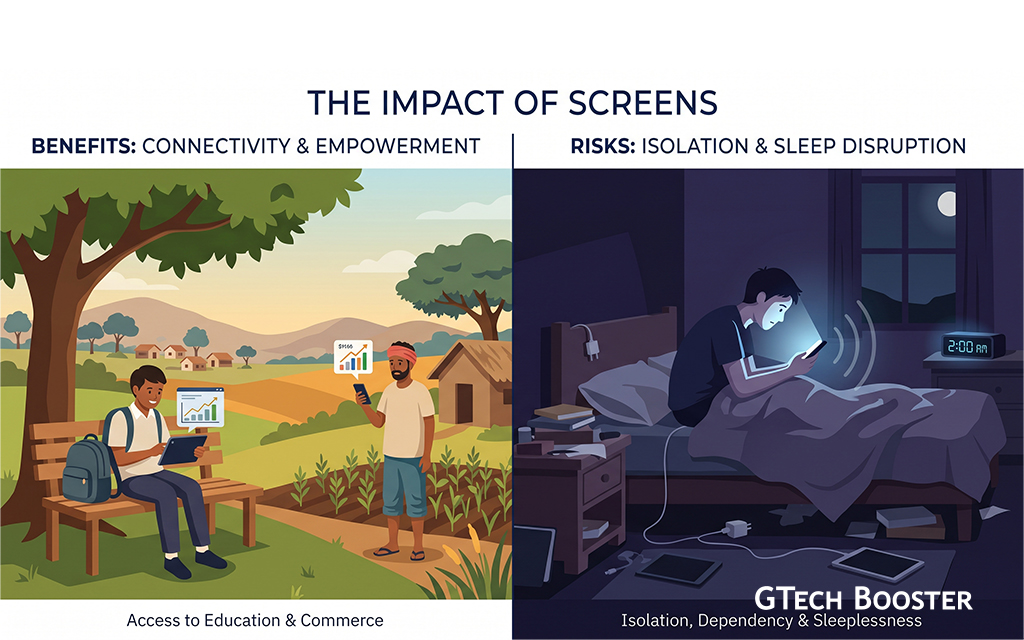
Screens give people access to health information, courses, news, and public services that were out of reach a generation ago. A student in a rural area can watch lessons from a world class teacher. A farmer can check market prices. A patient can book an appointment or consult a doctor remotely. In many countries, phones are also how people send money, pay bills, and run small businesses.
Connection and Support
For migrants, families separated by distance, and people with limited mobility, screens make regular contact possible. Online communities can offer support for people with rare conditions, minority identities, or isolating circumstances. Video calls have made it possible for grandparents to see grandchildren who live thousands of kilometers away.
Work, Economic Opportunity, and Creativity
Remote work, digital marketplaces, freelancing, content creation, and online learning have opened income opportunities for many people who would otherwise have had few. For these users, screen time is productive time, not wasted time.

Where Screen Time Is Linked to Harm
The concerns are real too, and they cluster in a few areas. It is important to keep in mind throughout this section that most of the research shows associations and not proven causes, a point returned to below.
Sleep
Screens late at night can delay bedtime, because videos, games, and social feeds are designed to keep people engaged. Light from screens and mental stimulation can also make it harder to fall asleep. Sleep is one of the most consistently reported areas of concern, and a recent systematic review and several other reviews have examined the link. A US government study of teenagers aged 12 to 17 found that those with four or more hours of daily non schoolwork screen time were more likely to report not feeling well rested and having an irregular sleep routine. That study could show only association, since it was a one time survey based on self reports.
Physical Activity and Body Health
Time on a screen is mostly sedentary, so it can replace physical activity. The same US study found that teens with high screen time were more likely to exercise infrequently and to report weight concerns. Long hours of sitting are linked more generally to poorer health. Screens can also cause eye strain, neck and back pain, and, for young children, may be linked to reduced active play.
Mental Health and Behavior
This is the most debated area. A large 2026 umbrella review reported in JAMA Pediatrics pooled 23 meta analyses covering about 2.8 million children and young people in 64 countries. It found that more screen use was linked with more anxiety and low mood and with more behavioral problems such as aggression and hyperactivity, but the relationships were small. The main correlation for anxiety and low mood was about 0.10, which means screen use accounts for roughly 1 percent of the differences between children on that measure. The review found no clear link with executive function, which covers skills like planning and self control.
Learning and Language
The same umbrella review found that more screen use was linked to lower overall school achievement and weaker language skills, again with small correlations of about 0.15 and 0.14. Results for reading, maths, and science taken separately were too uncertain to conclude anything. For very young children, hours spent on screens can mean fewer hours of talking, reading, and play with caregivers, which is when much early language develops.
Attention, Distraction, and Productivity
Constant notifications and switching between apps make it harder to concentrate for long periods. Many adults report that their phones interrupt work and study, though measuring the true effect on performance across a whole population is difficult.
Relationships and Social Life
Screens can strengthen relationships when they connect people, and weaken them when they replace face to face time or when people are physically together but absorbed in separate devices. Researchers often refer to this as displacement, meaning the harm comes from what the screen pushes out, not from the screen itself.
Why the Evidence Is Hard to Interpret
If screens are so common, why is there still so much disagreement? There are several reasons, and understanding them helps you read news stories on the topic with more care.
Correlation Is Not Causation
Most studies measure screen use and wellbeing at the same time. This cannot show which came first. A child who is anxious or lonely may spend more time on screens, rather than screens causing the anxiety. The umbrella review’s authors stress this limit, as do the authors of the US teen study.
Small Effects Across Large Populations
Even small average effects can matter across billions of people, but they are not large enough to predict what will happen to any one person. A correlation of 0.10 means that most of the differences between children are explained by other things, such as family circumstances, sleep, friendships, and health.
One Number for Very Different Activities
Screen time as a single total lumps together a video call with a grandmother, a maths app, a documentary, and hours of compulsive scrolling. Researchers increasingly say that content, context, age, and whether use is active or passive and intentional or compulsive tell us more than raw minutes do.
Self Reported and Inconsistent Measurement
Many studies rely on people estimating their own use, which is unreliable. Different surveys also define screen time differently, so numbers cannot always be compared.
Guidance for Young Children
For the youngest children, international health guidance is more specific. The World Health Organization’s guidelines for children under five, summarized by the American Optometric Association, recommend the following.
| Age | WHO recommendation on sedentary screen time |
|---|---|
| Under 1 year | Not recommended |
| 1 year | None |
| 2 years | No more than 1 hour, less is better |
| 3 to 4 years | No more than 1 hour |
The guidance also recommends that young children be physically active and get adequate sleep. A commentary on the 2026 review notes that in England there is currently no official numeric daily limit for ages 5 to 16, and that screen use is treated as a problem mainly when it crowds out sleep, physical activity, play, and family conversation.
The Wider Picture for Society
Looking at populations rather than individuals, screen time shapes quality of life in other ways too.
Inequality and the Digital Divide
Where screen based services are essential, people without devices, data, or digital skills are left out of education, banking, and jobs. At the same time, people with unlimited access can be overexposed to harmful content. Quality of life is affected by both too little and too much, and by the quality of what is accessed.
Health Systems and Public Spending
If sedentary habits and poor sleep become widespread, health systems may feel the cost over time through conditions linked to inactivity. The evidence connecting screen time directly to those long term outcomes is still developing.
Misinformation and Public Life
Screens are also how false information, scams, and manipulated media spread, which can erode trust and affect health decisions and elections. Time spent matters less here than what is consumed and how well people can judge it.
Practical Ways to Get the Benefits and Limit the Harm
The most useful advice focuses on what screens replace and how they are used.
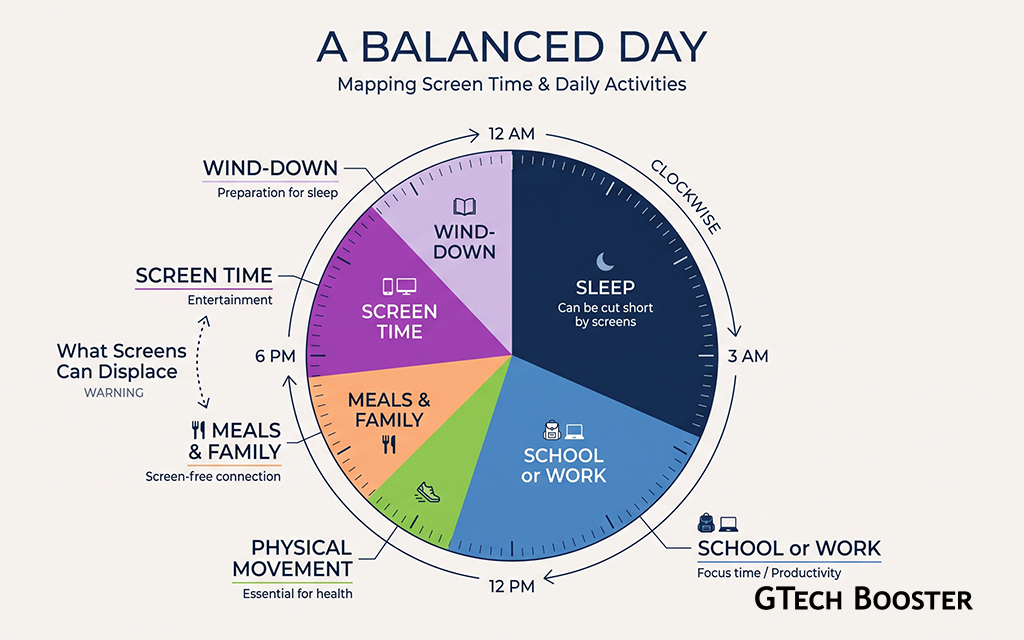
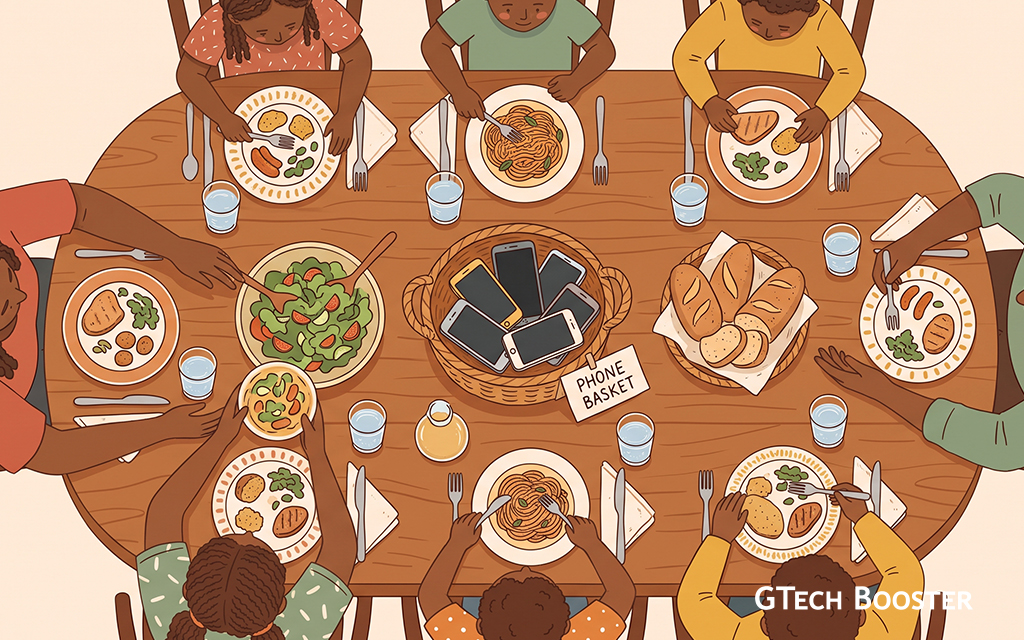
Protect sleep by keeping devices out of bedrooms where possible and avoiding screens in the hour before bed. Keep meals and conversations screen free so that time with others is not displaced. Make room for movement and outdoor time every day. For children, follow age appropriate guidance, watch together when you can, and pick quality content. Notice how you feel after using an app. If it leaves you anxious, angry, or drained, change how you use it. Use settings that limit notifications and set time limits that fit your own life. For adults, schedule breaks from screens during long work sessions to rest the eyes and body.
Bringing It All Together
Screen time is neither a simple poison nor a simple blessing. Screens now carry education, work, commerce, healthcare, and human connection for billions of people, and for many that is a real improvement in quality of life. Research also finds links between heavy use and poorer sleep, less physical activity, more anxiety and behavioral problems, and weaker school and language outcomes, particularly in children and teenagers. Those links are generally small, mostly come from studies that cannot prove cause, and vary with age, content, and context.
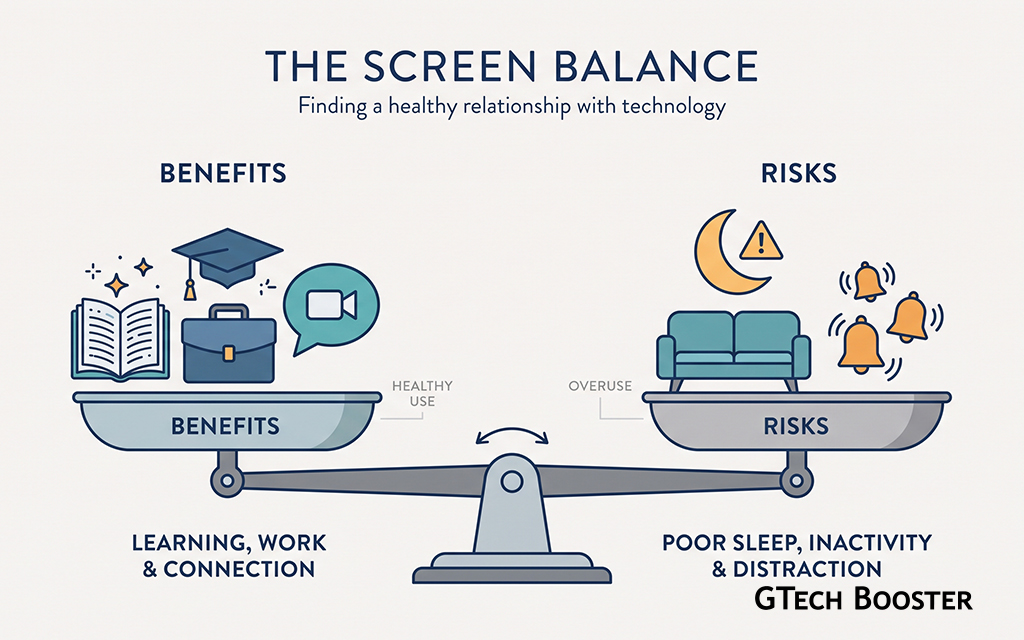
The most defensible conclusion is that the amount of time matters less than what it displaces and what is done with it. Screens harm quality of life most when they crowd out sleep, movement, play, and face to face relationships, and they help most when they provide learning, access, and genuine connection. Societies, schools, parents, and technology designers all have a role in making the second kind of use easier than the first.
More Information ℹ
















Conversation
Login to comment.
Log In / Register