How modern tennis spotlights the invisible
Modern tennis doesn’t just showcase power and speed; it also lays bare the “invisible” forces that shape how the game is played.

Have you ever watched a high-stakes tennis match and wondered how they are able to call a ball just a few millimeters out in a matter of seconds?. In a sport where a serve can clock in at over 150 mph, the human eye is physically incapable of consistently judging whether a fuzzy yellow blur grazed a white line or missed it by the width of a blade of grass.
By 2026, the human error element of line calling has largely moved into the history books, replaced by a sophisticated marriage of high-speed optics and multi-point triangulation. Here is the breakdown of the tech that makes those instant, heart-stopping decisions possible.
The Optical Net: High-Frame-Rate Cameras
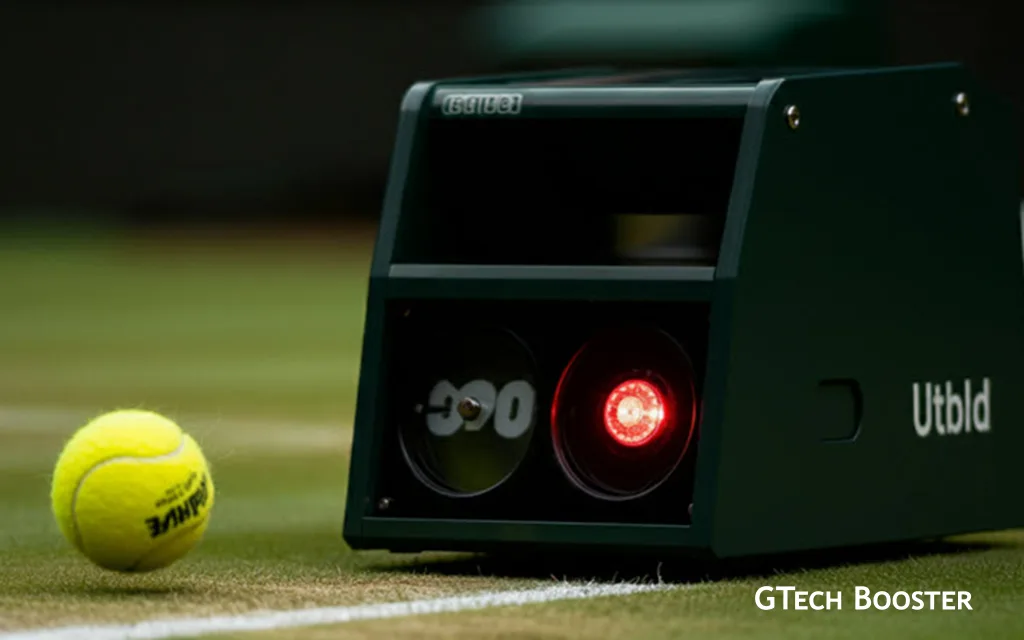
The backbone of modern tennis officiating is a system of high-speed, synchronized cameras positioned at strategic intervals around the court. Unlike a standard broadcast camera that captures 30 to 60 frames per second, these specialized units operate at upwards of 340 frames per second.
When a ball is struck, each camera tracks the center of that yellow circle in its own field of vision. Because the system knows the exact 3D coordinates of the court lines down to the millimeter, it can compare the ball’s flight path against the court’s physical boundaries in real time.

The Physics of the Squish
One of the most complex parts of spotting an out ball is accounting for the ball’s physical deformation. When a tennis ball hits the ground at high speed, it does not remain a perfect sphere; it compresses into an oval, increasing the surface area of the mark it leaves on the court.
The software calculates this compression patch. It does not just look at where the ball first touched the ground; it calculates the entire footprint of the impact. If even a single fiber of that compressed felt touches the outer edge of the white line, the ball is officially in.The system processes these geometric calculations almost instantly, sending a signal to the umpire’s watch or the stadium’s big screen before the crowd even has time to gasp.

Triangulation and the 3D Model
The tech uses a process called triangulation to ensure 100% accuracy. By combining the 2D data from at least five or six different camera angles, the central computer builds a 3D reconstruction of the ball’s trajectory.
This is why the system can “predict” the bounce with such certainty. It isn’t just seeing the bounce; it is calculating the arc of the flight. By the time the ball is halfway across the net, the system already has a projected landing zone. The moment of impact simply confirms the data the computer has been tracking since the ball left the opponent’s racket.

The Move to Electronic Line Calling (ELC)
While systems like Hawk-Eye were originally used as a challenge system where players could appeal a human’s call, 2026 has seen the widespread adoption of Live Electronic Line Calling(LELC). In this setup, there are no line judges on the court at all.
The system is integrated directly into the stadium’s audio. If the ball is out, an automated voice triggers an immediate out call through the speakers. This removes the 2-to-3 second delay of a human brain processing a visual and then shouting, leading to a faster, more fluid game where points are never interrupted by a bad call.
The bottom line
The automation of the baseline represents a milestone in the rise of Objective Sports Infrastructure. By shifting the burden of proof from human perception to high-frequency silicon, tennis has traded the drama of the argument for the unassailable authority of the algorithm.
In this landscape, the human element is no longer wasted on judging boundaries; it is reserved entirely for the athletes’ performance. We have reached a point where the integrity of the sport is no longer a matter of opinion or perspective. It is a matter of undeniable geometry, proved in real-time at the speed of light.
More Information ℹ
- 3d Film and what it holds in motion picture
- The Sub-Second Verdict: How Goal-Line Technology Solved Football’s Most Controversial Problem

















Conversation
Login to comment.
Log In / Register