Understanding Telecom Towers – What They Are and Their Role in Mobile Networks
Every phone call made, text message sent, and mobile data session used depends on a nearby telecom tower picking up the signal from a device and routing it into the wider communication network.
A telecom tower, also called a cell tower or a mobile mast, is a tall structure equipped with antennas and radio equipment that allows mobile phones and other wireless devices to connect to a mobile network. Every phone call made, text message sent, and mobile data session used depends on a nearby telecom tower picking up the signal from a device and routing it into the wider communication network.
At its core, a telecom tower exists to solve a simple physical problem. Radio signals used by mobile phones can only travel a limited distance before they weaken too much to be understood clearly. By placing antennas high above the ground, often on towers reaching thirty to over sixty meters tall, a much larger area can be covered from a single point, since height allows radio waves to travel further without being blocked by buildings, trees, or terrain.
The Basic Structure of a Tower Site
A telecom tower is rarely just a bare metal structure. A complete tower site typically includes several components working together. The tower itself provides height and structural support for antennas. The antennas mounted near the top send and receive radio signals to and from mobile devices in the surrounding area. At the base of the tower, a small equipment shelter or cabinet houses sensitive electronics, including radio units, batteries, and often a generator, which keep the site running even during power outages. Cabling connects the antennas at the top to the equipment at the bottom, carrying signals back and forth.
How a Telecom Tower Fits Into a Mobile Network
A single tower does not operate in isolation. It is one piece of a much larger, carefully coordinated system that allows a phone call to travel from one person to another, sometimes across an entire country or the world.
Cells and Coverage Areas
Each tower typically covers a geographic area known as a cell, which is the origin of the term cellular network. Cells are usually shaped like overlapping circles or hexagons on a coverage map, and neighboring cells are designed to overlap slightly at their edges. This overlap ensures that as a person moves, for example while driving, their phone can smoothly switch from one tower to the next without the call or data connection dropping, a process known as a handover.
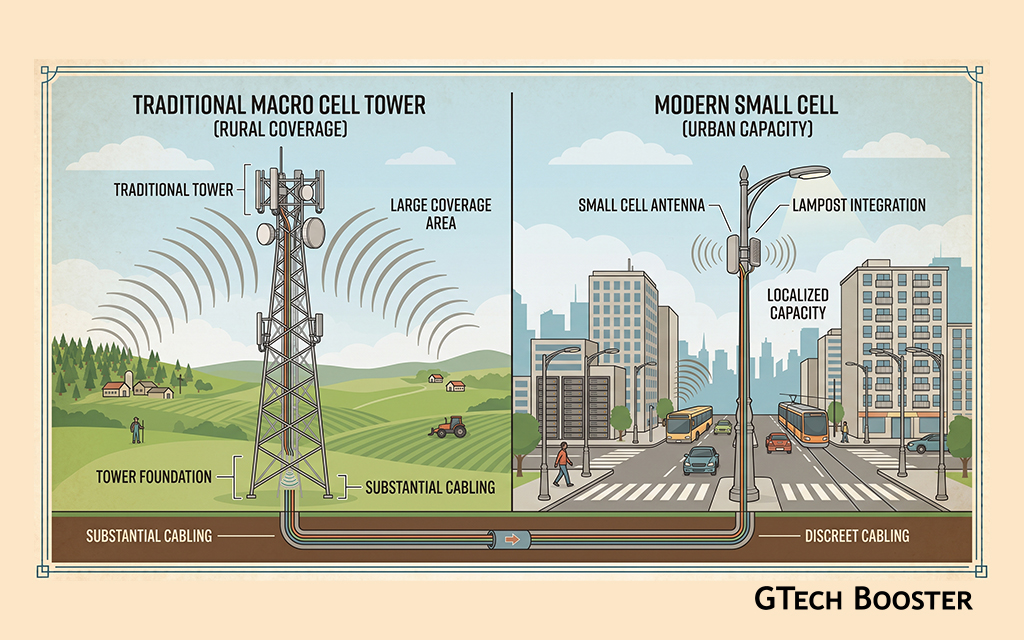
Towers are strategically placed based on population density and expected usage. Densely populated cities often have many towers positioned relatively close together, since a large number of people trying to use their phones in a small area can overwhelm a single tower’s capacity. Rural areas, by contrast, may have towers spaced much further apart, since fewer people need coverage across a wider area, and the priority shifts toward maximizing geographic reach rather than handling dense traffic.
From Antenna to Network Core
When a phone sends a signal to a nearby tower, that is only the first step in a much longer journey. The tower’s equipment converts the radio signal into a form that can be transmitted onward, typically through fiber optic cable, a microwave radio link, or another dedicated connection, toward the mobile operator’s core network. The core network is the central system responsible for figuring out where a call or message needs to go, verifying that the user’s account is valid, and managing the overall functioning of the network.
If a call is being made to another mobile phone, the core network identifies which tower is currently closest to the recipient’s phone and routes the signal there, where it is finally converted back into a radio signal and sent to that phone’s antenna. This entire process, from one phone to a tower, through the core network, and back out through another tower to a second phone, typically happens in a fraction of a second.
Supporting Multiple Generations of Technology
Telecom towers are not tied to a single type of mobile technology. The same physical tower often hosts equipment supporting multiple generations of mobile networks simultaneously, including older 2G and 3G equipment alongside newer 4G LTE and 5G equipment. This layered approach allows operators to gradually upgrade their networks without needing to build entirely new towers each time a new generation of technology is introduced, while also ensuring older devices that only support earlier technologies can still connect.
Newer technologies, particularly 5G, sometimes require towers to be placed closer together than earlier generations did, since some of the higher frequency radio waves used by 5G travel shorter distances and are more easily blocked by obstacles. This has led to an increase not only in traditional tall towers but also in smaller, less conspicuous equipment mounted on lampposts, buildings, and other existing structures in urban areas, often referred to as small cells.
Why Telecom Towers Matter
The importance of telecom towers becomes clearest when considering what happens without them. A mobile phone, no matter how advanced, is essentially useless for calls, texts, or data without a nearby tower to connect to. Towers form the physical backbone that makes mobile communication possible at all, turning a device carried in someone’s pocket into a tool connected to the rest of the world.
Enabling Everyday Communication
Every voice call, text message, and mobile internet session a person uses throughout the day relies on this infrastructure functioning correctly. Towers allow people to stay connected while traveling, coordinate emergencies, run businesses from a mobile device, and access information from virtually anywhere within a network’s coverage area.
Supporting Economic and Social Development
In many parts of the world, especially in regions where laying physical internet cables to every home is impractical or expensive, mobile networks built on telecom towers serve as the primary way people access the internet and communication services at all. This makes towers not just a technical convenience but a genuine driver of economic activity, education, and access to services like mobile banking, particularly in areas where alternative infrastructure is limited.
Reliability and Redundancy
Because so much depends on them, telecom towers are typically built with reliability in mind. Backup batteries and generators allow a tower site to continue operating for a period of time even if the main power supply fails, which is especially important during storms, natural disasters, or other emergencies when communication becomes even more critical. Mobile operators also plan their tower networks with a degree of overlap and redundancy, so that if one tower experiences a problem, nearby towers can often help absorb some of the additional demand.
Bringing It All Together
A telecom tower may appear to be a simple, unremarkable structure from the outside, yet it functions as a critical link between a mobile phone in someone’s hand and the vast, interconnected system that makes modern communication possible. By holding antennas high above the ground, a tower extends the reach of relatively weak radio signals across a wide area, forming a cell that a phone connects to. That connection is then carried through equipment at the base of the tower into a mobile operator’s core network, which figures out where the signal needs to go next.
Towers work together across a landscape, overlapping just enough to allow seamless movement from one coverage area to another, while supporting multiple generations of technology simultaneously to serve both older and newer devices. Understanding this role transforms a tall metal structure often overlooked on a hillside or rooftop into what it truly is, a fundamental piece of infrastructure quietly enabling nearly every mobile interaction people rely on each day.
More Information ℹ


















Conversation
Login to comment.
Log In / Register