Understanding the Update to AdSense Impression Measurement
At its core, this update changes the precise moment at which an ad impression is counted as having happened. Understanding why this matters requires first understanding how impressions have traditionally been measured and why that measurement point has practical consequences for anyone earning money from display advertising.

Google has announced a change to how it counts display ad impressions across AdSense and Google Ad Manager. Publishers were notified of this update in early September 2026, and the change itself takes effect on 17th of February, 2027. It applies to display ad inventory served on the web, mobile web, and connected television, and it does not require any action from publishers to enable, since Google applies it automatically on the effective date.
At its core, this update changes the precise moment at which an ad impression is counted as having happened. Understanding why this matters requires first understanding how impressions have traditionally been measured and why that measurement point has practical consequences for anyone earning money from display advertising.
What Is an Ad Impression?
An ad impression is the basic unit of measurement in online advertising, representing one instance of an ad being served to a user. Every time an ad appears, or is intended to appear, on a webpage or app, that event is typically counted as one impression. Impressions form the foundation for a huge portion of how digital advertising is measured, priced, and reported, since metrics like cost per thousand impressions, commonly abbreviated as CPM, depend directly on how many impressions have been recorded.
Because so much depends on this single number, the exact rule used to decide when an impression officially counts matters a great deal. Two ads that both technically reached a user’s browser might still differ meaningfully in whether that user ever actually had a chance to see them, and different measurement methodologies draw that line in different places.
The Old Method: Count on Download
Under the method AdSense has used for its display ad inventory, known as Count on Download, an impression is recorded as soon as an ad begins downloading to a user’s device. This means the counting happens quite early in the overall process of loading and displaying a page. If an ad begins to download but the user leaves the page, closes the tab, or otherwise never actually sees that ad rendered on their screen, the impression can still be recorded under this method, simply because the download process began.
This approach has a notable side effect. It counts a certain number of impressions that never actually reached a viewable state on screen, since starting a download is not the same as an ad successfully appearing where a person could see it.
The New Method: Begin to Render
The new methodology, called Begin to Render, moves the counting point later in the process. Under this system, an impression is only counted once an ad has successfully loaded and has actually begun rendering, meaning it has started to visually appear on the user’s screen. If a visitor navigates away from a page before the ad reaches that point, no impression is recorded at all, regardless of whether a download had already started.
In simple terms, the old method asked whether an ad started loading, while the new method asks whether an ad actually reached the screen. This is a meaningfully different question, and it naturally results in a stricter, more conservative count of what qualifies as a genuine impression.
Why Google Is Making This Change
Google has described this update as part of an effort to align its measurement approach with established industry standards, specifically referencing benchmarks set by organizations such as the Interactive Advertising Bureau and the Media Rating Council, both of which are widely recognized authorities on advertising measurement practices. Begin to Render is already considered the preferred approach across much of the digital advertising industry, since it more closely reflects whether a person genuinely had an opportunity to view an ad rather than simply whether a technical download process began.
Notably, this change also brings display ad measurement in line with how other ad formats within Google’s own systems already work. Native ads, in app inventory, and video ads have already been using Begin to Render or functionally equivalent methodologies for some time, measured through approaches such as first frame detection for video content. Display ads on the web have remained the one major format still relying on the older Count on Download approach, and this update effectively closes that gap, unifying impression counting across Google’s advertising products.
There is also a practical benefit for the broader advertising ecosystem. Discrepancies between how a publisher counts impressions and how an advertiser or third party measurement provider counts the same impressions have long been a source of friction and reconciliation work between both sides of the advertising relationship. Aligning AdSense with an already widely used industry standard is expected to reduce these kinds of counting mismatches going forward.
What This Means for Publishers
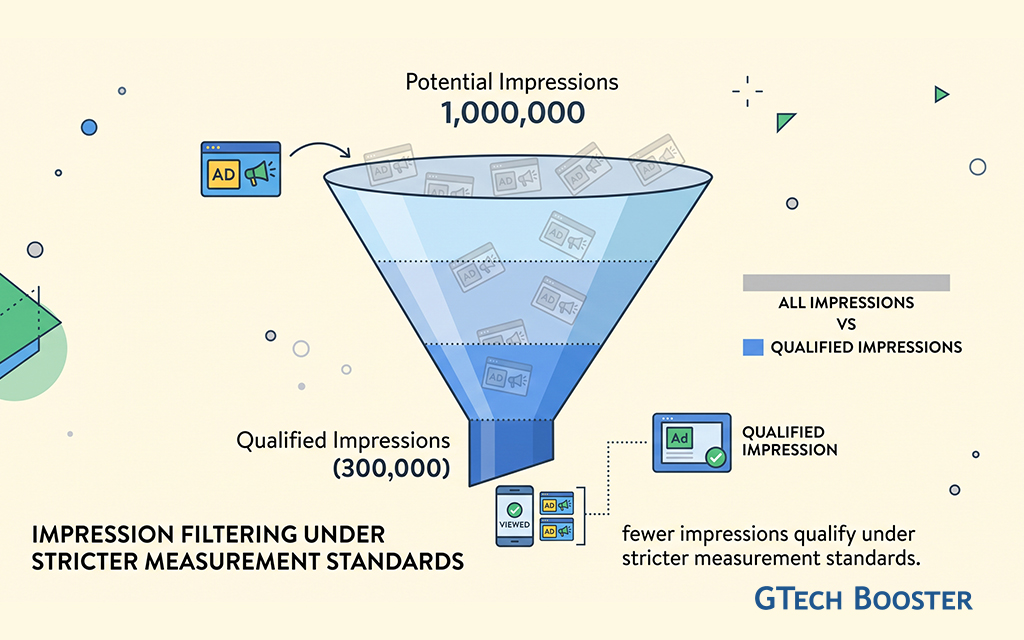
For anyone running AdSense ads on a website, the most immediate and visible effect of this change will be a shift in the total number of impressions reported in their dashboard. Google has been direct in stating that publishers may notice a decrease in total impressions once the new methodology takes effect, since impressions that previously counted simply because a download began, but that never actually rendered on screen, will no longer be included in the total.
Impressions May Fall, But Revenue Should Not
An important distinction to understand is that this change affects how impressions are counted, not how much advertising revenue a publisher earns. The ad impressions being removed from the count under the new methodology were, by definition, impressions that a user never actually saw rendered on their screen. These were generally impressions with little to no genuine advertising value in the first place, since an ad that never visually appeared had no real opportunity to be seen or clicked. As a result, while the total impression count may fall, publishers should not expect a proportional drop in the actual earnings those impressions were generating.
Why CPM Figures Will Look Different
Because CPM is calculated by dividing revenue by the number of impressions, removing a portion of unrendered impressions from the denominator, while revenue stays relatively stable, naturally causes the calculated CPM figure to rise. This does not represent advertisers suddenly paying more for the same ads. It reflects a more accurate accounting of how many ads actually reached a viewer, spread across a now smaller, but more meaningful, impression count.
Comparing Data Before and After the Change
One of the more important practical considerations for publishers is that comparing impression totals or CPM figures from before February 17, 2027 directly against figures from after that date will not produce a meaningful comparison, since the two periods measure fundamentally different events under fundamentally different definitions. Google has suggested that publishers using Ad Manager can build reports comparing the older download based impression count against the newer begin to render based count, using historical data available from mid August 2026 onward, in order to establish a clearer sense of how large this shift will be for their specific site or app before it takes full effect.
How Publishers Can Prepare
Given that the change applies automatically and requires no technical action to enable, most of the practical preparation for publishers centers on understanding and communicating the shift rather than making changes to their sites. Establishing a clear baseline before the transition date, by reviewing historical reporting that compares the old and new counting methods side by side, allows a publisher to anticipate roughly how much their reported impression numbers might shift once the new method becomes standard.
It is also worth publishers preparing to explain this shift to anyone who relies on their reporting, including advertisers, sponsors, or internal stakeholders who may notice a change in headline impression numbers without immediately understanding the reason behind it. Framing the conversation around the fact that impression definitions have changed, rather than suggesting that traffic or ad performance itself has declined, helps avoid confusion once the new figures begin appearing in dashboards.
Finally, shifting some attention toward metrics less sensitive to this particular change, such as total advertising revenue or revenue calculated per user session, can provide a steadier and more consistent way to track overall performance across the transition period, since these figures are not affected by where exactly the line is drawn for counting an individual impression.
Bringing It All Together
The update to AdSense impression measurement represents a shift in definition rather than a shift in advertising performance itself. By moving from a method that counted impressions the moment an ad began downloading to a method that only counts an impression once an ad has actually begun rendering on a user’s screen, Google is tightening its measurement standard to better reflect genuine viewing opportunities, while also aligning display ads with the methodology already used across its other ad formats and with broader industry standards.
For publishers, the practical outcome is a lower total impression count paired with a largely unaffected revenue figure, resulting in a higher calculated CPM that reflects more accurate measurement rather than any real change in advertiser spending. Understanding this distinction, and preparing reporting and stakeholder communication accordingly well before the February 2027 transition date, allows publishers to interpret their post change numbers correctly rather than mistaking a measurement update for a genuine decline in their site’s advertising performance.
More Information ℹ


















Conversation
Login to comment.
Log In / Register