The Standard Model of Particle Physics
At its core, the Standard Model answers two questions. What is everything made of? And how do the pieces interact with one another?
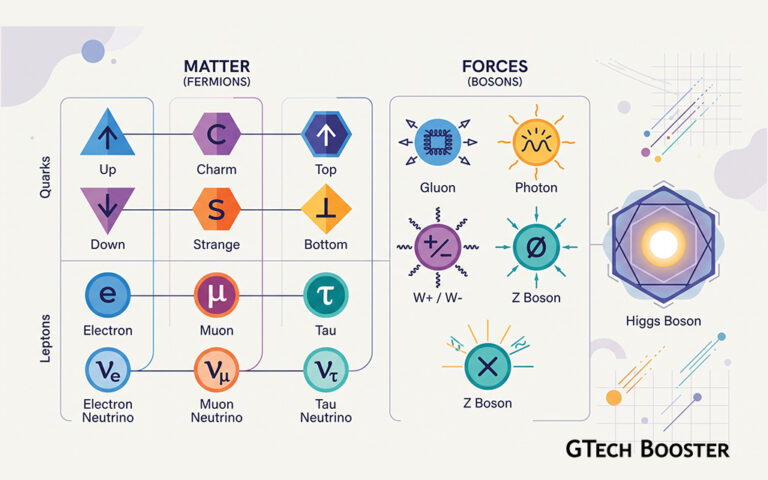
The Standard Model is a theory constructed for describing the fundamental building blocks of matter and the forces that govern them. Developed over the course of the 20th century through the combined work of hundreds of physicists, it attempt to provide understanding of three of the four known fundamental forces (electromagnetism, the weak nuclear force, and the strong nuclear force) while cataloguing every known elementary particle. It does not yet incorporate gravity, and it leaves several deep mysteries unresolved. Multiple cultures tell stories of the formation of the building blocks of matter; the standard model tries to explain it through contemporary physics.
At its core, the Standard Model answers two questions. What is everything made of? And how do the pieces interact with one another? The answer to the first question is a set of particles called fermions. The answer to the second is a set of particles called bosons, which carry the forces between fermions.
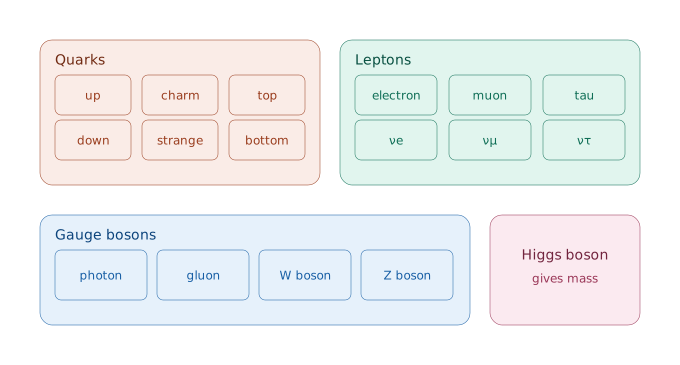
The Two Families of Particles
All particles in the Standard Model fall into one of two broad categories, distinguished by a quantum property called spin.
Fermions are the particles of matter. They have half-integer spin (1/2 in natural units) and obey the Pauli exclusion principle, which states that no two identical fermions can occupy the same quantum state at the same time. This principle is why matter takes up space and doesn’t simply collapse into a single point. It’s the reason atoms have structure, chemistry exists, and solid objects don’t pass through one another.
Bosons are the particles that transmit forces. They have integer spin (0 or 1) and do not obey the exclusion principle, meaning many bosons can occupy the same state simultaneously. This property is what allows phenomena like laser light, where enormous numbers of photons behave coherently together.
The Fermions: Building Blocks of Matter
Fermions are further divided into two types, quarks and leptons, and each type comes in three “generations” of increasing mass.
Quarks
Quarks are the constituents of protons, neutrons, and a wide array of other composite particles known as hadrons. There are six types, or “flavors,” of quarks, organized into three generations:
- First generation: up (u) and down (d), the lightest quarks, and the only ones found in ordinary, stable matter. A proton consists of two up quarks and one down quark; a neutron consists of one up quark and two down quarks.
- Second generation: charm (c) and strange (s)
- Third generation: top (t) and bottom (b), the heaviest quarks. The top quark, discovered in 1995, is heavier than an entire gold atom.
Quarks carry fractional electric charge (+2/3 or −1/3 of the electron’s charge) and a property called color charge, which comes in three types (red, green, blue) and is the source of the strong force. Crucially, quarks are never observed in isolation. A phenomenon called color confinement binds them permanently into color-neutral composite particles like protons and neutrons.
Leptons
Leptons are the second family of matter particles, and unlike quarks, some of them can exist freely. There are also six leptons in three generations:
- First generation: the electron (e⁻) and the electron neutrino (νₑ)
- Second generation: the muon (μ⁻) and the muon neutrino (ν_μ)
- Third generation: the tau (τ⁻) and the tau neutrino (ν_τ)
The electron, muon, and tau all carry a full unit of negative electric charge and differ mainly in mass. The muon is about 207 times heavier than the electron, and the tau is about 3,477 times heavier. Neutrinos, by contrast, are electrically neutral and were long thought to be massless. We now know they have a tiny but nonzero mass, a discovery that itself points to physics beyond the Standard Model.
Why Three Generations?
Only the first generation of fermions makes up stable, everyday matter. The second and third generations are heavier, unstable copies that decay rapidly into first-generation particles and are typically only produced in high-energy events like cosmic ray collisions or particle accelerator experiments. Why nature repeats the pattern three times, and not two or four, remains one of the open questions the Standard Model does not explain.
The Bosons: Carriers of Force
Forces in the Standard Model are described as the exchange of force-carrying bosons between fermions. Each of the three forces included in the model has its own carrier(s).
The Photon and Electromagnetism
The photon (γ) is the carrier of the electromagnetic force. It is massless and travels at the speed of light, mediating interactions between any electrically charged particles. Electromagnetism governs chemistry, light, electricity, and magnetism.
The W and Z Bosons and the Weak Force
The W⁺, W⁻, and Z bosons carry the weak nuclear force, responsible for processes like radioactive beta decay and the nuclear fusion reactions that power the Sun. Unlike the photon, these bosons are massive. The W boson weighs about 80 times the mass of a proton, and the Z boson about 91 times. Their large mass is why the weak force has such a short range, acting only across distances smaller than an atomic nucleus.
The Gluon and the Strong Force
Gluons carry the strong nuclear force, which binds quarks together inside protons and neutrons, and also binds protons and neutrons together inside atomic nuclei. There are eight types of gluons, distinguished by different combinations of color and anti-color charge. Unusually, gluons themselves carry color charge, meaning they can interact with one another, a feature that makes the strong force mathematically far more complex than electromagnetism and directly responsible for quark confinement.
The Higgs Boson
The Higgs boson, discovered at CERN’s Large Hadron Collider in 2012, is unique among the bosons: it does not carry a force in the same sense as the others. Instead, it is the observable excitation of the Higgs field, a field that permeates all of space. Particles acquire mass by interacting with this field. The more strongly a particle couples to the Higgs field, the more massive it becomes. This mechanism, proposed in 1964 by Peter Higgs and others (including Robert Brout, François Englert, Gerald Guralnik, C. R. Hagen, and Tom Kibble), explains why the W and Z bosons are massive while the photon and gluon are not, and why fermions have the varied masses they do. Its experimental confirmation was considered one of the most significant achievements in physics of the 21st century.
The Mathematical Structure
The Standard Model is formulated as a quantum field theory built on a specific mathematical symmetry structure, written as:
SU(3)_C × SU(2)_L × U(1)_Y
Each factor corresponds to one of the fundamental interactions:
- SU(3)_C describes the strong force and the color charge of quarks and gluons; this part of the theory is called quantum chromodynamics (QCD).
- SU(2)_L × U(1)_Y describes the electroweak force, a unification of electromagnetism and the weak force that was theorized by Sheldon Glashow, Abdus Salam, and Steven Weinberg in the 1960s and 70s. At high energies, the electromagnetic and weak forces merge into a single electroweak force. At the lower energies of everyday experience, this symmetry is “broken” by the Higgs mechanism into the separate electromagnetic and weak forces we observe.
This framework, combining electroweak unification and QCD, is what physicists mean when they refer to “the Standard Model.”
Antimatter
Every fermion in the Standard Model has a corresponding antiparticle with identical mass but opposite electric charge and other quantum numbers. The antiparticle of the electron is the positron; quarks have antiquarks. When a particle meets its antiparticle, the two annihilate, converting their mass into energy, typically in the form of photons. The universe’s overwhelming imbalance between matter and antimatter, despite the Big Bang presumably producing equal amounts of both, remains an unsolved puzzle known as baryon asymmetry.
Experimental Triumphs
The Standard Model’s predictions have been confirmed to remarkable precision. Notable achievements include:
- The discovery of the W and Z bosons at CERN in 1983, confirming electroweak unification.
- The discovery of the top quark at Fermilab in 1995, completing the third generation of quarks.
- The measurement of the electron’s magnetic moment, which agrees with Standard Model predictions to better than one part in a trillion, one of the most precisely verified predictions in the history of science.
- The discovery of the Higgs boson in 2012, confirming the mechanism by which particles acquire mass.
What the Standard Model Doesn’t Explain
Despite its successes, the Standard Model is understood to be incomplete. Major open questions include:
- Gravity: The model has no description of gravity, which is instead explained separately by Einstein’s general relativity. Unifying gravity with quantum mechanics remains one of the central unsolved problems in physics.
- Dark matter and dark energy: Astronomical observations indicate that ordinary matter, everything described by the Standard Model, makes up only about 5% of the universe’s total mass-energy content. The rest is dark matter and dark energy, neither of which has a place in the current model.
- Neutrino mass: The Standard Model originally predicted massless neutrinos, but experiments have shown they have small but nonzero masses, requiring an extension to the theory.
- Matter-antimatter asymmetry: The model does not adequately explain why the universe contains so much more matter than antimatter.
- The hierarchy problem: There is no explanation within the model for why the Higgs boson’s mass is so much smaller than theoretical expectations would suggest, given quantum corrections from other particles.
- Too many free parameters: The model requires around 19 experimentally measured constants (particle masses, coupling strengths, mixing angles) that it cannot predict from first principles.
The Standard Model stands as one of humanity’s greatest intellectual achievements: a compact mathematical framework that accounts for the behavior of matter and forces across an enormous range of scales, from the inside of atomic nuclei to the cores of stars. Yet its very success sharpens the mystery of what lies beyond it. Physicists continue to search, through experiments at facilities like the Large Hadron Collider and through astronomical observation, for the next layer of theory that will explain dark matter, unify gravity with the quantum world, and answer why the universe is built the way it is.
More Information ℹ


















Conversation
Login to comment.
Log In / Register