The History and Role of USSD in Mobile Telecom – A 2G Legacy Technology Still Widely Used
Born as a supplementary feature of the second generation, GSM based mobile networks of the early 1990s, USSD has outlived the network generation that created it, continuing to function reliably on 3G, 4G LTE, and even 5G networks decades after it was first standardized.
Unstructured Supplementary Service Data, universally known by its acronym USSD, is one of the quietest but most consequential technologies in the history of mobile telecommunications. It has no app icon, no dedicated marketing campaign, and no glossy interface, yet it remains the backbone of mobile money, airtime top-up, customer self-service, and basic connectivity for hundreds of millions of people, particularly across Africa, South Asia, and parts of Latin America. Born as a supplementary feature of the second generation, GSM based mobile networks of the early 1990s, USSD has outlived the network generation that created it, continuing to function reliably on 3G, 4G LTE, and even 5G networks decades after it was first standardized. This account traces the origins of USSD, explains how the technology actually works at a technical level, and examines the outsized role it continues to play in global mobile telecom, particularly in regions where it has become critical infrastructure for financial inclusion.
Part One: Origins and Standardization
The GSM Era and the Need for a Flexible Signaling Channel
USSD emerged out of the standardization work behind the Global System for Mobile Communications, the digital cellular standard that began rolling out across Europe in the early 1990s and quickly became the dominant mobile technology worldwide. GSM engineers needed a way for mobile operators to offer supplementary services, features beyond a basic voice call, such as checking account balance, changing certain network settings, or accessing operator specific menus, without needing to build an entirely separate data channel or standardize every possible feature in advance.
The technical specifications defining USSD were published by the European Telecommunications Standards Institute, appearing across a family of GSM technical specifications, most notably GSM 02.90, which described the stage one functional requirements, and GSM 03.90, which described the underlying stage two and stage three technical mechanisms for how USSD messages were actually structured, transported, and processed within the network. These specifications were finalized in the mid to late 1990s, placing USSD firmly among the earliest supplementary services built into the GSM standard, alongside things like call forwarding and call waiting, which are also triggered using similar star and hash code sequences.
A Deliberately Unstructured Protocol
The word “unstructured” in the protocol’s name is a deliberate and important design choice. Unlike other GSM supplementary services, which were tightly standardized with fixed formats for every possible operation, USSD was designed to carry an essentially free form string of characters between the handset and a network application, with the content and meaning of that string left entirely up to whatever application was running on the network side. This meant individual mobile operators, and later third party service providers connecting through operator gateways, could define their own custom menus, prompts, and services without needing international standards bodies to approve every new use case. This flexibility, combined with the fact that USSD required no new hardware in the handset beyond what was already built into every GSM phone to support signaling, is the single biggest reason the technology spread so widely and so quickly.
Part Two: How USSD Actually Works
The Session Based, Real Time Connection
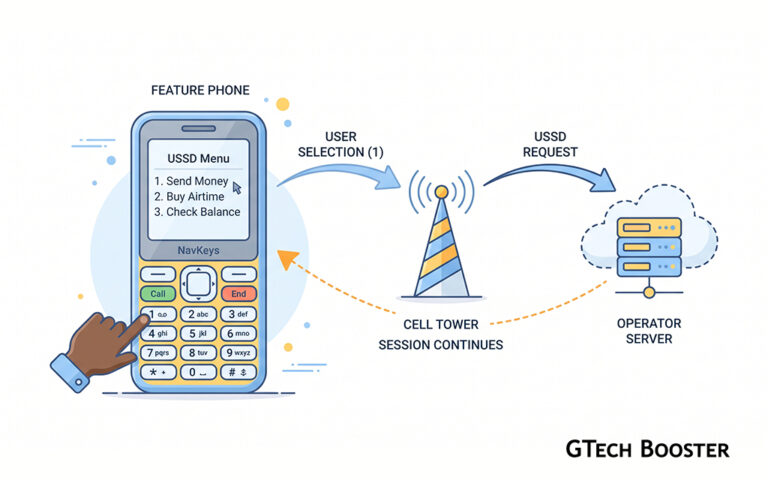
USSD operates fundamentally differently from Short Message Service, even though the two are often lumped together in casual conversation as competing text based technologies. When a user dials a USSD code, typically a string beginning with an asterisk, containing a sequence of digits, and ending with a hash or pound symbol, such as a balance inquiry code, the handset opens a live, real time signaling session directly with the network, using the same signaling channel that handles call setup and other control functions rather than the store and forward messaging channel that SMS relies on.
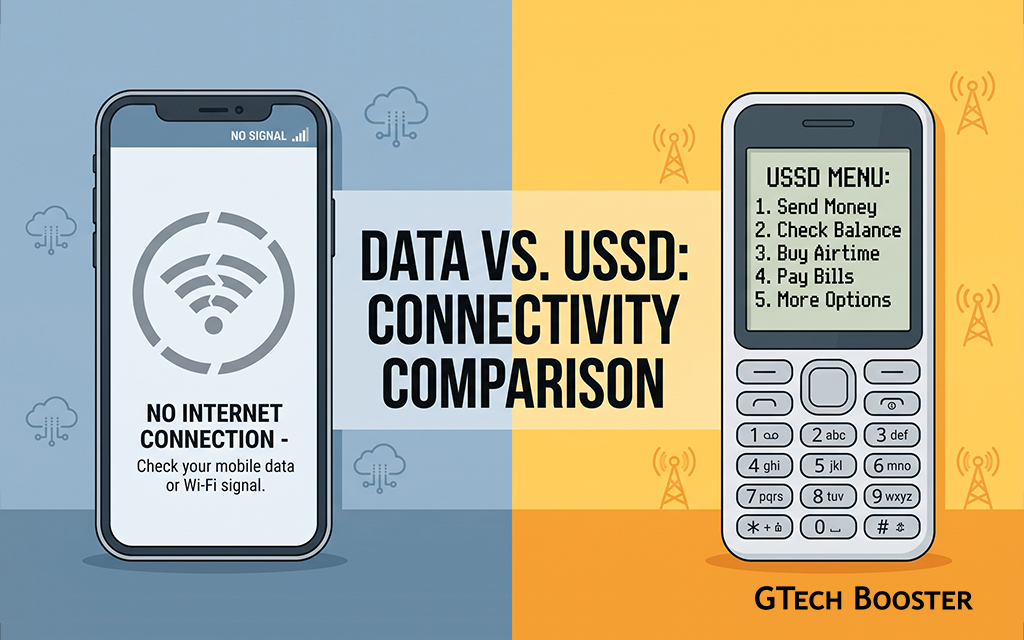
This session remains open for the duration of the interaction, allowing a genuine back and forth exchange, the network can send a menu of options back to the phone, the user can select one, the network can respond with a follow up prompt, and so on, all within a single continuous session, similar in spirit to a live conversation rather than a series of separate, independently delivered messages. Because the session stays open and uses the signaling path rather than a queued message store, USSD responses tend to arrive noticeably faster than SMS, and because it operates over the control channel rather than a data bearer, it works even in areas or on device configurations where standard mobile data service is poor or entirely unavailable, as long as basic GSM signal coverage is present.
Message Size and Structure
A single USSD message is limited to a relatively small payload, generally cited as up to 182 alphanumeric characters, encoded within the network’s underlying signaling protocols. In practice, most real world USSD exchanges are far shorter than this maximum, typically a short numbered menu of a handful of options, since the interface has to be readable on the very basic monochrome text screens of even the oldest and simplest mobile handsets.
Network Architecture and Routing
Within the network, a USSD request from a handset is picked up by the mobile switching center, the core GSM network element responsible for handling call and session control. Historically the request would be routed either to a supplementary service application handled directly by network elements like the home location register or visitor location register, or, far more commonly for anything beyond built in operator functions, forwarded to a dedicated USSD gateway. This gateway acts as the bridge between the mobile network’s signaling world and external applications, translating incoming USSD sessions into requests that back end systems, banking platforms, customer service systems, content providers, or third party businesses, can process, and then translating their responses back into the correct signaling format to send back to the user’s handset. This gateway architecture is what eventually allowed USSD to become a general purpose platform for building interactive mobile services well beyond what the original GSM standard authors likely imagined, including complex multi step menus for banking, agriculture information services, health services, and voting or polling applications.
Mobile Originated Versus Network Initiated Sessions
Most USSD interactions that ordinary users encounter are mobile originated, meaning the subscriber dials the code and initiates the session themselves. The standard also supports network initiated USSD, in which the network or an application can push a USSD session to a subscriber’s phone without the user dialing anything first, commonly used by operators to send prompts such as low balance warnings, promotional offers, or menu based surveys that appear as a pop up style prompt on the handset.
Part Three: The Original Uses of USSD
In its earliest years, USSD was used almost entirely for functions defined and controlled directly by mobile network operators themselves. Classic early applications included checking prepaid airtime balance, checking the phone’s own number when it was not otherwise readily visible, activating or deactivating certain network features and supplementary services, configuring call forwarding rules, and providing access to basic operator information menus. Because these codes worked identically across virtually every GSM handset regardless of manufacturer or software version, they became deeply familiar, near universal conventions, still recognizable today in codes like those used to check a device’s unique hardware identifier or to temporarily block caller identification on an outgoing call.
USSD was also adopted early on as a mechanism for Wireless Application Protocol related interactions and other lightweight information and location based content services, giving operators a way to offer simple interactive services to the enormous base of basic feature phones that lacked any real web browsing capability of their own.
Part Four: The Transformation Into a Platform for Financial Inclusion
Why USSD Became the Backbone of Mobile Money
The single most significant chapter in the history of USSD is its adoption as the primary interface for mobile money services across the developing world, most famously in sub-Saharan Africa. In markets where a large share of the population did not have a bank account, did not own a smartphone, and often did not have reliable or affordable mobile data access, USSD offered something uniquely valuable: an interactive, menu driven interface that worked on the cheapest, most basic mobile handset available, required no app download, no data plan, and no literacy with anything beyond simple numbered menus, and functioned even in areas with only the most minimal GSM signal coverage.
Kenya’s M-Pesa service, launched by Safaricom in March 2007, is widely credited as the pioneering and most successful example of mobile money in the world, and it demonstrated conclusively that a mobile network operator could build a full scale financial services platform on top of the phone’s basic messaging and menu capabilities rather than requiring smartphones or internet banking infrastructure. While M-Pesa’s earliest transaction mechanics leaned heavily on SIM based menu technology and SMS confirmation messages, the broader mobile money industry that followed across Africa and beyond overwhelmingly standardized on USSD as the primary customer facing interface, since it offered a more consistent, real time, interactive session across a far wider range of handsets and network conditions than SMS based menus could reliably provide. Dialing a short code and navigating a live numbered menu to send money, buy airtime, pay a bill, or check a balance became, and remains, the everyday reality of mobile banking for an enormous population across the continent.
Geographic Spread
Following the success of mobile money in Kenya, USSD based financial services spread rapidly across Tanzania, Uganda, Ghana, Nigeria, Rwanda, Zimbabwe, and dozens of other African markets, each typically anchored around a short, easily memorized dial code operated by the dominant mobile network operator or a banking consortium. Similar patterns emerged in South Asia, including in India, Pakistan, and Bangladesh, where USSD based interfaces support banking, government services, and telecom account management for hundreds of millions of subscribers who may have only basic feature phones or limited, expensive mobile data. Latin American and Southeast Asian markets have adopted USSD to varying degrees for similar purposes, generally in proportion to how large a share of the population relies on lower end handsets and prepaid mobile plans rather than smartphones with continuous data connectivity.
Beyond Banking: A General Purpose Service Delivery Channel
Once the mobile money use case proved the model, USSD was rapidly adapted for an enormous range of additional services well beyond financial transactions. Agricultural information services use USSD to deliver crop prices, weather forecasts, and farming advice to rural farmers who may have no other reliable access to this information. Health organizations have built USSD based systems for appointment reminders, medication adherence support, disease outbreak reporting, and even basic electronic health record access in regions with limited internet infrastructure. Government agencies across multiple developing countries use USSD for citizen identification verification, tax payment, voter registration confirmation, and public service information. Telecom operators themselves continue to rely heavily on USSD for self care menus, allowing subscribers to check data balances, purchase bundles, manage subscriptions, and access customer support without needing a working data connection or a smartphone app, which is particularly valuable during outages or for subscribers who have exhausted their data allowance and would otherwise have no way to purchase more.
Part Five: Why USSD Has Survived Into the 4G and 5G Era
Technological Persistence Across Generations
USSD is fundamentally a signaling layer technology, tied to the control and session management functions of the mobile core network rather than to the specific radio access technology of any one generation. This is the key technical reason it has continued to function across 3G UMTS networks, 4G LTE networks, and now 5G networks, even as the underlying radio technology, data speeds, and network architecture have changed dramatically. Operators have continued to support USSD signaling paths within their modern core networks specifically because so many critical services, mobile money chief among them, and so many subscribers, particularly older devices and price sensitive prepaid users, continue to depend on it.
Reliability in Poor Coverage and Low End Devices
USSD’s continued relevance also rests on a set of practical advantages that remain true today just as they were in the 1990s. It works on virtually any mobile handset ever manufactured for GSM style networks, including the most basic feature phones still sold new in many markets specifically because of their low cost and long battery life. It requires no data connection, no app installation, and no operating system compatibility considerations, which matters enormously in regions where mobile data remains expensive relative to income or where network coverage is inconsistent, particularly in rural areas. It also carries no direct cost to the end user in most implementations, unlike SMS, which is often charged per message, making USSD menus attractive to both operators seeking to reduce customer support costs and to service providers targeting price sensitive populations.
Trust, Simplicity, and Digital Literacy
There is also a significant behavioral and trust dimension to USSD’s persistence. For populations with limited digital literacy or limited trust in smartphone apps and internet based services, a simple numbered menu accessed by dialing a short, memorable code feels more familiar and less intimidating than downloading and navigating a banking app, and it does not expose the user to the same concerns around malware, app permissions, or account security that can create hesitancy around smartphone based financial apps. This trust factor has been a meaningful contributor to sustained USSD adoption even as smartphone penetration has grown substantially across many of the same markets.
Part Six: Limitations and Security Considerations
Technical Limitations
Despite its resilience, USSD carries real limitations that have shaped, and constrained, how it is used. The tiny message size and lack of any rich formatting mean USSD interfaces are limited to simple, shallow menu trees, unsuitable for anything approaching the complexity of a modern app interface. Sessions can time out relatively quickly if a user takes too long to respond, forcing them to restart an entire transaction from the beginning. USSD sessions are also generally single threaded and stateful in a fairly primitive way, which historically created real engineering challenges for service providers trying to build reliable, high volume transactional systems, such as mobile money platforms processing millions of daily transactions, on top of an infrastructure never originally designed for that scale of use.
Security Concerns
USSD’s underlying signaling channel was designed in an era with far less sophisticated security threats than exist today, and this has created genuine vulnerabilities. Because USSD messages are not encrypted end to end in the way modern internet traffic typically is, and because the protocol was never designed with strong authentication built into the core mechanism itself, USSD based services have historically been targeted by fraud schemes, including social engineering attacks that trick users into dialing malicious USSD codes that can trigger call forwarding to a fraudster controlled number, or session hijacking style attacks targeting weaknesses in how some mobile money platforms handle USSD session authentication, particularly around personal identification number entry within a session. Security researchers have also documented cases where malicious mobile applications silently triggered USSD codes in the background without the user’s knowledge or consent, exploiting device level access. Mobile operators and financial service providers have responded over time with additional authentication layers, session timeout tightening, encrypted backend transport between the USSD gateway and downstream applications, and stronger fraud monitoring, though the fundamental signaling channel itself remains less inherently secure than modern encrypted data based alternatives.
Part Seven: USSD Alongside and Against Newer Technologies
The Competitive Landscape
As smartphone penetration and mobile data affordability have both increased substantially across the markets where USSD is most heavily used, dedicated banking and service apps, along with SMS based one time password systems and internet based digital wallets, have emerged as competing or complementary channels for many of the same services USSD historically dominated. In markets with high smartphone adoption and cheap data, app based interfaces generally offer a richer experience, stronger built in security through modern encryption and biometric authentication, and the ability to support far more complex transactions and features than a USSD menu ever could.
Why USSD Has Not Been Displaced
Despite this competition, USSD has not disappeared, and in many markets it remains the dominant or even the only viable channel for a very large share of the population. Millions of subscribers, particularly older users, rural populations, and the most price sensitive prepaid customers, continue to use basic feature phones incapable of running smartphone apps at all. Even among smartphone owners, unreliable or expensive mobile data can make a lightweight, no data required USSD session more practical for a quick balance check or money transfer than opening a data hungry app. Providers of mobile money and telecom services have therefore generally maintained USSD channels in parallel with newer app based options rather than retiring them, treating USSD as an essential fallback and inclusion channel rather than a legacy relic to be phased out.
Voice Over LTE and the Question of Long Term Survival
One ongoing technical consideration is how USSD support is carried forward as mobile networks continue to modernize their core infrastructure, particularly as some operators plan eventual retirement of older 2G and 3G radio networks in favor of infrastructure built primarily around 4G and 5G, sometimes alongside Voice over LTE and Voice over New Radio for voice calls. Because USSD is fundamentally a signaling function rather than a radio access technology, operators have generally worked to preserve USSD signaling support within their evolving core networks even as the underlying radio layer changes, recognizing the enormous installed base of services and users who still depend on it. However, this does require deliberate engineering effort on the part of operators to maintain USSD gateway compatibility as core network technology evolves, and the long term trajectory of USSD support will likely continue to depend heavily on how quickly smartphone adoption, mobile data affordability, and alternative digital identity and payment infrastructure mature in the specific markets that currently rely on it most heavily.
USSD stands as a remarkable case study in technological longevity, a supplementary feature built into the earliest specifications of second generation mobile networks that went on to become the foundation of financial inclusion for hundreds of millions of people who might otherwise have remained entirely outside the formal banking system. Its survival across three subsequent generations of mobile technology owes less to any single deliberate strategic decision and more to a combination of practical virtues that have proven remarkably durable: universal handset compatibility, resilience in poor network conditions, freedom from data connectivity requirements, and a simple interface accessible to users regardless of digital literacy or device sophistication. While newer, richer, and more secure technologies continue to expand their reach, USSD’s continued relevance across Africa, South Asia, and other developing regions is a reminder that in telecommunications, as in many fields, the technology that ultimately matters most is often not the newest or most sophisticated one, but the one that reliably reaches the greatest number of people where they actually are.
More Information ℹ


















Conversation
Login to comment.
Log In / Register