Understanding USSD – What It Is and How It Differs from SMS and Voice Calls
Most people encounter USSD without knowing its name, typically when they dial a code such as star, some numbers, and a hash symbol, and a small menu pops up on the screen offering choices like checking account balance, buying data bundles, or sending mobile money.
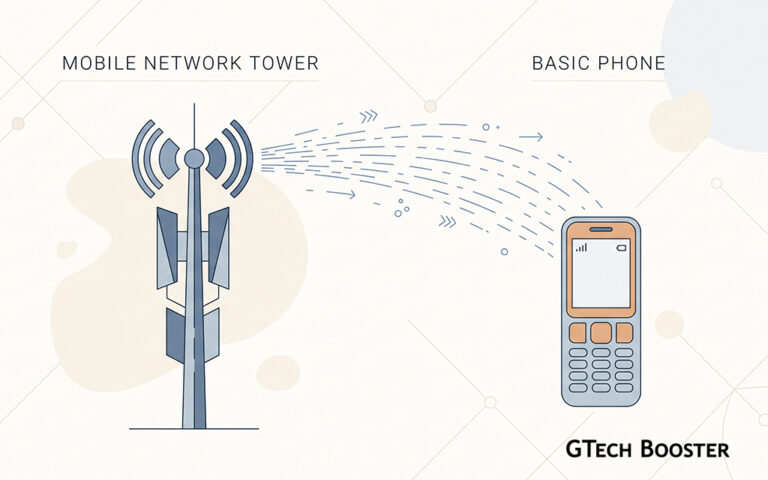
USSD stands for Unstructured Supplementary Service Data. It is a communication protocol built into mobile networks that allows a phone to exchange short bursts of text with a service running on the network operator’s systems, in real time. Most people encounter USSD without knowing its name, typically when they dial a code such as star, some numbers, and a hash symbol, and a small menu pops up on the screen offering choices like checking account balance, buying data bundles, or sending mobile money.
Unlike apps that require an internet connection, USSD works over the same signaling channel that a phone uses to communicate basic control information with the cellular network. This means USSD sessions can function on the most basic mobile phones, including devices with no internet capability at all, as long as they can connect to a GSM network.
How a USSD Session Works
When a user dials a USSD code, the phone sends that code to the network. The network routes the request to whichever service is linked to that code, commonly a bank, a mobile money platform, or the network operator itself. That service then sends back a menu of options as plain text, which appears on the phone’s screen. The user responds by typing a number corresponding to their choice, and this exchange continues back and forth until the task is completed or the session times out.
This back and forth exchange happens within a single continuous session, meaning the connection stays open the entire time the menu is being used, similar in spirit to a conversation rather than a series of separate messages. Once the user completes their task or the session is closed, the connection ends entirely, and nothing is stored for later reference.
How USSD Differs from SMS
Although USSD and SMS both rely on a mobile network rather than the internet, and both are often confused with one another, they work in fundamentally different ways.
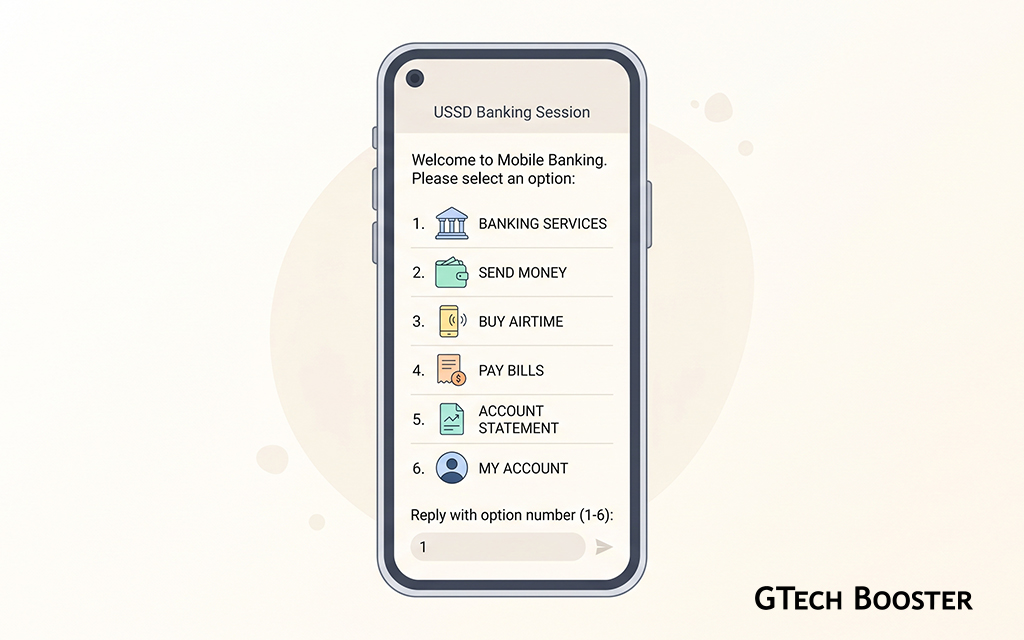
Session Based vs Message Based
The clearest difference lies in how the communication is structured. USSD operates as a session, staying connected throughout an entire interaction, with each screen the user sees depending directly on their previous response. SMS, by contrast, is message based. Each text message is sent and received as an individual, self contained unit, with no ongoing connection linking one message to the next.
This means a USSD interaction feels like navigating a live menu, while an SMS conversation feels like exchanging separate notes that happen to relate to the same topic.
Speed and Real Time Interaction
Because USSD keeps a session open, responses tend to arrive almost instantly, making it well suited for interactive tasks like checking a balance or navigating a menu of options. SMS messages, while usually fast, are not guaranteed to arrive immediately since they pass through a store and forward system, meaning the network holds onto a message and delivers it when possible, which occasionally introduces delays.
Cost and Data Storage
USSD sessions are typically not stored on the phone once they end, so there is no record left behind in a messaging app afterward. SMS messages, on the other hand, are saved to the phone’s inbox and remain accessible until deleted, providing a written record. Many mobile operators also price USSD and SMS differently, and in various regions, USSD is offered as a lower cost or even free service specifically because it is commonly used for essential tasks like mobile banking.
Common Use Cases
USSD is generally used for short, interactive, and often financial or account related tasks that benefit from a guided menu, such as mobile money transfers, checking airtime balance, or activating a subscription plan. SMS tends to be used for straightforward, one way or two way messaging, such as personal conversations, appointment reminders, or one time passwords sent for verification purposes.
How USSD Differs from Voice Calls
Voice calls and USSD may both use core mobile network infrastructure, but they serve entirely different purposes and function in very different ways.
Nature of Communication
A voice call carries live audio between two people or between a person and an automated system, allowing for natural spoken conversation. USSD carries only text based menus and short numeric or alphabetic responses, with no audio involved whatsoever. A person using USSD reads options on their screen and types a response, rather than speaking or listening.
Human Interaction vs Automated Menus
Voice calls typically connect a caller either to another person or to an automated interactive voice response system, commonly known as an IVR, where the caller listens to recorded prompts and presses buttons or speaks in response. USSD replaces the need for listening to audio prompts entirely, instead displaying the same kind of menu structure directly as readable text, which many users find faster and less frustrating than sitting through spoken options.
Accessibility and Environment
Voice calls require a quiet enough environment to hear and be heard, and they are not practical in noisy or silence required settings. USSD, being entirely text based, works discreetly and silently, making it usable in a meeting, on public transportation, or anywhere a phone call would be inappropriate or difficult to conduct.
Cost Structure
Voice calls are generally billed based on the length of the call, meaning a longer conversation costs more. USSD sessions, being extremely brief and menu driven, are typically billed as a flat fee per session or offered free of charge, since they usually take only a few seconds to complete regardless of how many menu screens are involved.
Why USSD Remains Important Today
Even as smartphones and mobile internet access continue to expand, USSD remains a critical technology, particularly in regions where reliable internet connectivity is not guaranteed or where a significant portion of the population still relies on basic mobile phones. Because USSD does not depend on an internet connection or a smartphone operating system, it offers a dependable way to reach essential services like banking, healthcare information, and government programs to virtually anyone with a mobile signal.
Mobile money, one of the most transformative financial technologies in many critical economies, relies heavily on USSD precisely because of this universal accessibility. A farmer with a basic phone and no data plan can still send money, check a balance, or pay a bill using nothing more than a short code and a few taps on a keypad.
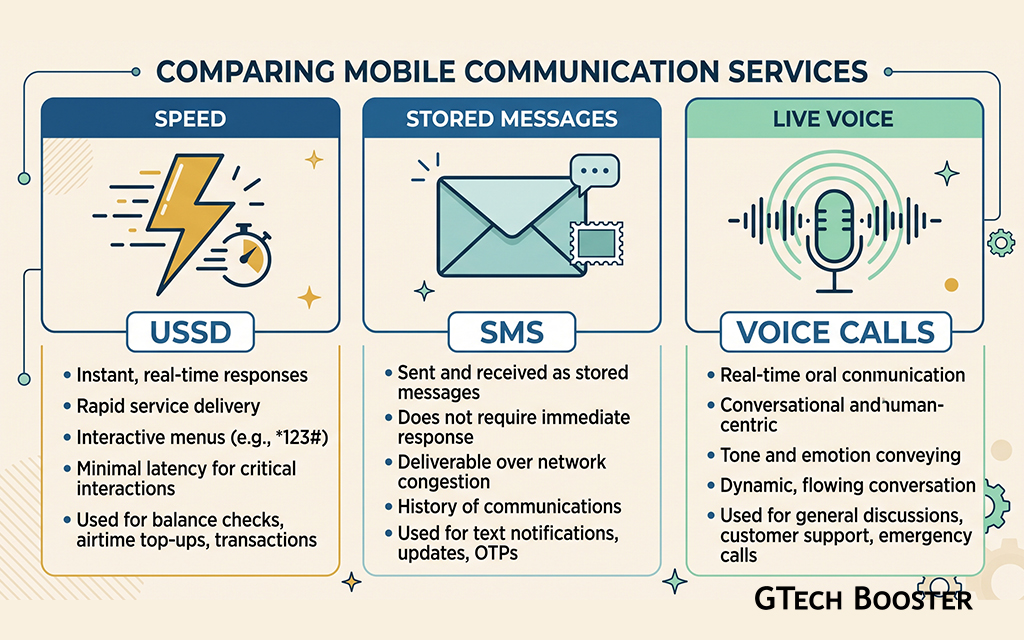
Bringing It All Together
USSD, SMS, and voice calls each rely on different mechanisms and each serve different purposes within the same mobile network. USSD provides fast, interactive, session based menus ideal for short tasks like banking or subscription management, without leaving a stored record behind. SMS offers asynchronous, stored text messaging suited to conversations and notifications that do not require an immediate back and forth. Voice calls deliver live spoken communication, ideal for nuanced conversation but requiring an appropriate environment and typically costing more for longer use.
Understanding these distinctions clarifies why a bank might send a one time password by SMS, offer balance checks through USSD, and still maintain a voice call center for complex customer support issues, since each technology is suited to a different kind of interaction.
More Information ℹ


















Conversation
Login to comment.
Log In / Register