DRM – A Detailed Look at Digital Rights Management
Despite how pervasive it is, DRM remains one of the more genuinely contested topics in technology, sitting at the intersection of copyright law, software engineering, consumer rights, and business strategy.
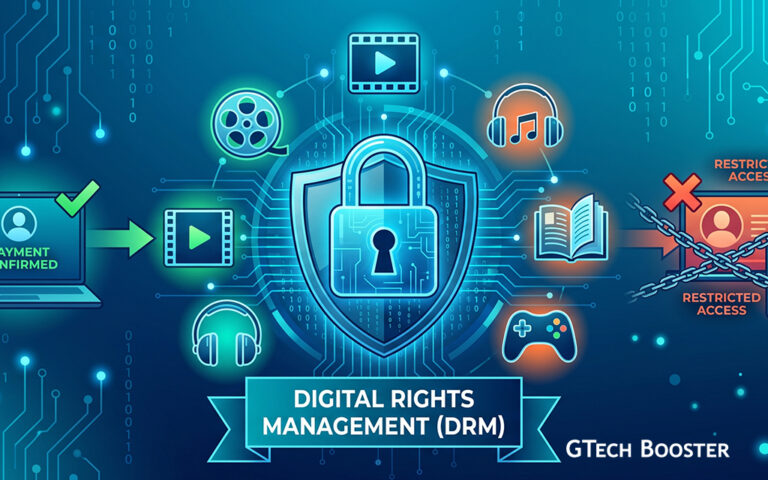
Almost every piece of digital media a typical person interacts with today, the movies streamed on a subscription service, the ebooks bought for an e-reader, the games installed on a console or PC, and the music played through a streaming app, is wrapped in some form of Digital Rights Management, commonly abbreviated DRM. Despite how pervasive it is, DRM remains one of the more genuinely contested topics in technology, sitting at the intersection of copyright law, software engineering, consumer rights, and business strategy. This article explains what DRM actually is, how it works technically, where it shows up across different types of media, and lays out the substantive arguments both for and against it.
What DRM Actually Is
Digital Rights Management refers to a broad category of technologies used to control how digital content can be accessed, copied, modified, and shared after it has been distributed to a customer. The underlying goal, from the perspective of a content owner or publisher, is to restrict unauthorized copying and distribution of copyrighted material, allowing the rights holder to maintain control over how their content gets used even after it has left their direct possession and landed on a customer’s own device.
DRM is not a single specific technology but rather a broad category encompassing many different technical approaches, all aimed at the same general goal through different mechanisms. Some systems focus on encrypting content so it can only be decrypted and played by authorized software or hardware. Others focus on licensing servers that must be contacted before content can be accessed at all. Still others use watermarking to trace unauthorized copies back to their original source, without necessarily preventing copying outright.
How DRM Actually Works Technically
Encryption and decryption keys
The most common technical foundation for DRM is encryption. Content, whether a video file, an ebook, or a piece of software, is encrypted before distribution, meaning it is scrambled into an unreadable format using a cryptographic algorithm. A corresponding decryption key is required to unscramble that content back into a usable form. Rather than simply handing the decryption key over to the customer alongside the encrypted content, DRM systems typically manage that key through a separate, controlled process, often requiring the playback software or device to authenticate with a remote licensing server before it is permitted to obtain the key needed to decrypt and play the content.
License servers and authentication
Many modern DRM systems, particularly for streaming video and audio, rely on an active licensing model rather than a one-time key delivered alongside the content itself. When a user attempts to play a piece of protected content, their playback software contacts a remote license server, which verifies that the request is authorized, whether by checking an active subscription status, a purchase record, or some combination of device and account authentication. Only after that verification succeeds does the license server issue a decryption key, often one with restrictions attached, such as an expiration time or a limit on how many devices can be authorized to use it simultaneously.
Hardware-level protection
Some DRM implementations extend protection down into the hardware itself rather than relying purely on software. High-bandwidth Digital Content Protection, commonly known as HDCP, is a widely used example, encrypting video signals as they travel between a playback device, such as a Blu-ray player or streaming box, and a display, such as a television or monitor, specifically to prevent the video signal from being intercepted and recorded at that physical connection point. This kind of hardware-rooted protection is generally considered more difficult to circumvent than purely software-based approaches, since it requires compromising physical hardware behavior rather than simply reverse-engineering a piece of software running on a general-purpose computer.
Watermarking as a complementary approach
Rather than preventing copying outright, watermarking embeds hidden, typically imperceptible identifying information directly into the content itself, information that survives even if the content is copied, converted to a different file format, or re-recorded. If an unauthorized copy later surfaces publicly, the embedded watermark can potentially be used to trace that specific copy back to the account or device it originated from. This approach is commonly used in combination with encryption-based DRM rather than as a complete replacement for it, providing an additional layer of accountability specifically aimed at deterring leaks rather than technically preventing copying in the first place.
Where DRM Shows Up Across Different Media
Video streaming
Major streaming platforms rely heavily on a small number of dominant DRM systems built directly into web browsers and operating systems: Google’s Widevine, Apple’s FairPlay, and Microsoft’s PlayReady are the three most widely deployed systems, and a given streaming service typically supports multiple systems simultaneously to cover the full range of devices and browsers its customers might use (There is also Huawe’s WisePlay DRM). These systems generally combine encrypted video streams with license servers that verify an active subscription or rental period before issuing playback keys, and they often support different protection tiers, allowing a streaming service to require a higher level of hardware-backed security for higher-resolution content, such as 4K video, than for standard-definition streams.
Music
Music DRM has followed a notably different trajectory than video. Major music retailers and streaming services largely abandoned DRM on purchased, downloadable music files during the late 2000s, with Apple’s iTunes Store removing DRM from its music catalog in 2009, a shift driven partly by record labels themselves concluding that DRM was doing more to frustrate paying customers than to meaningfully deter piracy. Music streaming subscription services, by contrast, still commonly use DRM-like access controls, though the mechanism functions somewhat differently from download-based DRM, since the content is typically streamed on demand rather than downloaded and stored in a persistently protected file.
Ebooks
Ebook DRM remains widespread and is often implemented in ways that specifically tie a purchased book to a particular platform’s own ecosystem. Amazon’s Kindle platform is the most prominent example, using its own proprietary DRM system that generally prevents Kindle-purchased books from being read on non-Amazon devices or apps without additional conversion steps, a practice that has drawn sustained criticism for effectively locking customers into a single retailer’s ecosystem for their entire purchased digital library.
Video games
Games represent some of the most technically aggressive and most publicly controversial DRM implementations. Beyond basic license verification, PC gaming has seen dedicated anti-tamper and anti-piracy systems, most notably Denuvo, specifically engineered to make it difficult for pirates to crack a game’s protection during the commercially critical early sales window immediately following release. Games have also historically used always-online requirements, mandating a persistent internet connection and server check-in even for single-player content with no genuine multiplayer component, a practice that has drawn particularly intense criticism when publishers later shut down the authentication servers a game depends on, rendering the game permanently unplayable even for customers who paid for it legitimately.
Software more broadly
Beyond games specifically, general software has long used various licensing and activation mechanisms, from simple serial number checks to more sophisticated online activation systems requiring periodic reverification with a vendor’s licensing server, aimed at preventing unauthorized installation across more devices than a given license actually permits.
The Legal Framework Behind DRM
DRM’s technical protections are backed up by specific legal frameworks that make circumventing them a separate legal issue from copyright infringement itself. In United States, the Digital Millennium Copyright Act, passed in 1998, includes anti-circumvention provisions that make it illegal to bypass DRM protections, in many cases regardless of whether the underlying act of accessing the content would itself have constituted copyright infringement. This means that circumventing DRM to access content a person has, in some sense, a legitimate right to access, such as making a personal backup copy of a legally purchased disc, can still constitute a separate legal violation purely for defeating the technical protection measure itself. The European Union has similar anti-circumvention provisions built into its Copyright Directive framework, reflecting a broadly similar legal approach across major Western jurisdictions, treating the circumvention of technical protection measures as a distinct legal wrong independent of traditional copyright infringement. On the continents of Asia and Africa, the pieces are fragmented with no clear outlooks mostly due to lack of indigenous system support and the stack contrast with interfaces with implementations outside their continents.
The Case Made in Favor of DRM
Proponents of DRM, generally rights holders, publishers, and platform operators, make several substantive arguments in its favor.
It provides a technical backstop supporting content licensing business models.
Streaming subscriptions, digital rentals, and time-limited access models depend on being able to actually enforce those access limits technically, rather than relying purely on trust or legal deterrence after the fact. Without some form of DRM, a subscription streaming model offering access to a large content library for a low monthly price becomes considerably harder to sustain, since nothing would technically prevent a single paying subscriber from freely redistributing that entire library to non-subscribers.
It can reduce piracy during commercially critical windows.
Particularly for games and newly released movies, sales and viewership are heavily concentrated in the days and weeks immediately following release. DRM systems specifically engineered to resist cracking during that narrow window, even if they are eventually defeated later, can meaningfully protect revenue during the period that matters most commercially, even without achieving permanent, unbreakable protection.
It supports continued investment in content production.
Rights holders argue that without meaningful technical protection against unauthorized copying, the economic incentive to invest heavily in producing expensive films, games, and other media would be undermined, since revenue would be harder to reliably capture from the audience actually consuming the content.
It enables more flexible licensing and pricing models.
DRM allows rights holders to offer content through a wider range of pricing structures, permanent purchases, time-limited rentals, subscription-based access, and geographically restricted releases, structures that depend on the ability to technically enforce the specific terms of each individual transaction.
The Case Made Against DRM
Critics, including many consumer advocates, digital rights organisations, archivists, and a meaningful share of legitimate paying customers, raise a distinct and substantial set of counterarguments.
DRM primarily inconveniences legitimate customers rather than stopping piracy.
A frequently made argument is that DRM protections are, in practice, eventually circumvented by determined pirates regardless of how sophisticated the protection is, while ordinary paying customers are the ones left dealing with the resulting restrictions, compatibility problems, and reduced flexibility in how they can actually use content they have legitimately purchased.
Purchased content can become permanently inaccessible.
Because DRM-protected content frequently depends on an active license server or ongoing platform support, a customer’s access to content they believe they own outright can disappear entirely if the platform shuts down, discontinues support, or revokes access for any reason, a risk that does not exist with unprotected physical or digital media. This has happened repeatedly with digital storefronts closing and services discontinuing DRM validation servers, leaving previously purchased content unusable.
It complicates preservation and archival efforts.
Libraries, archivists, and digital preservation researchers have specifically raised concerns that DRM makes it substantially harder to preserve digital works for long-term historical and cultural access, since standard archival practices often depend on the ability to freely copy, migrate, and maintain access to material over long time horizons, practices DRM is specifically designed to restrict.
It can restrict legally recognized uses of purchased content.
Activities widely understood as legitimate under copyright law’s fair use or similar doctrines in other jurisdictions, such as making a personal backup copy, using excerpts for commentary or criticism, or adapting content for accessibility purposes, such as text-to-speech conversion for visually impaired users, can be technically blocked by DRM even when the underlying use would not itself constitute infringement, and circumventing that technical block can itself carry separate legal risk under anti-circumvention law.
It can create genuine accessibility and interoperability problems.
DRM-protected content frequently only functions correctly on a limited set of approved devices, software versions, or platforms, creating real friction for customers using older hardware, alternative operating systems, or assistive technology not explicitly supported by a given DRM system’s approved device list.
Some research questions its actual effectiveness against sophisticated piracy operations.
Critics point to the consistent pattern of even heavily protected, expensively engineered DRM systems eventually being defeated by dedicated piracy groups, arguing that the primary practical effect of increasingly aggressive DRM is not meaningfully deterring committed piracy operations, but rather increasingly burdening the legitimate paying customers who make up the actual target market DRM is nominally meant to protect revenue from.
The Middle Ground: DRM-Free Alternatives and Movements
Not every part of the digital content industry has embraced DRM uniformly, and a meaningful DRM-free movement exists specifically as a counter-position. Some digital storefronts, most notably the PC gaming platform GOG, formerly known as Good Old Games, have built their entire brand identity specifically around selling DRM-free versions of games, marketing this as a direct customer benefit, the ability to own and keep a functional copy of purchased software indefinitely, regardless of what happens to the storefront or publisher later. Similarly, as noted earlier, the major music industry largely abandoned DRM on purchased downloadable music files, a shift that came directly from record labels themselves, reflecting at least a partial acknowledgment within the industry that DRM’s downsides, in that specific context, outweighed its benefits.
Wrapping Up
DRM sits at a genuine, unresolved tension between two legitimate sets of interests: rights holders seeking to protect the commercial viability of content they have invested significant resources into producing, and customers, archivists, and accessibility advocates seeking the kind of durable, flexible ownership and access that has historically come with physical media and unprotected digital files. Both sides of this debate rest on substantive, defensible arguments rather than one side being simply correct, and the specific technical implementation of DRM, and its practical consequences for ordinary customers, varies considerably across different types of media and different companies’ specific approaches. Understanding DRM as a genuinely contested policy and technology question, rather than either an unambiguous necessity or an unambiguous consumer harm, is the most accurate way to approach a technology that now sits quietly underneath a substantial share of the digital content the average person interacts with every single day.
More Information ℹ


















Conversation
Login to comment.
Log In / Register