Schrödinger’s Paradox
It challenges our deepest assumptions about reality and reveals just how strange the quantum world can be.
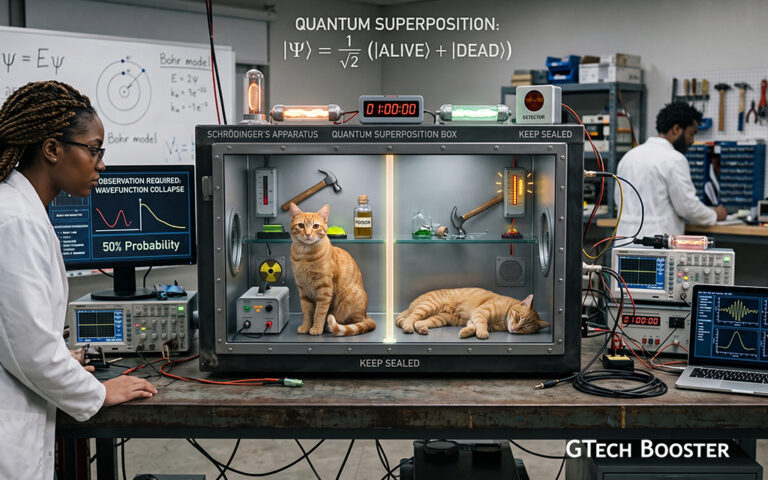
Can something be both alive and dead at the same time? At first glance, the idea sounds impossible. Yet this unsettling question lies at the heart of one of the most famous thought experiments in the history of science: Schrödinger’s cat. Often referred to as the Schrödinger paradox, it challenges our deepest assumptions about reality and reveals just how strange the quantum world can be.
In 1935, Austrian physicist Erwin Schrödinger proposed the thought experiment to illustrate the bizarre implications of quantum mechanics. Imagine a cat sealed inside a box with a tiny amount of radioactive material, a radiation detector, and a vial of poison. If a single atom decays, the detector triggers the release of the poison, killing the cat. If the atom does not decay, the cat survives. According to one interpretation of quantum mechanics, until the box is opened and the system is observed, the atom exists in a quantum superposition of both decayed and undecayed states. As a result, the cat is mathematically described as being in a superposition of both alive and dead.
Schrödinger did not create this experiment because he believed a real cat could exist in such a state. Quite the opposite. He intended it as a critique of applying the strange rules of quantum mechanics directly to everyday objects. His paradox exposed the tension between the quantum world, where particles can exist in multiple possible states, and the classical world, where objects appear to have definite properties.
Over the decades, scientists have developed several interpretations to explain the paradox. The Copenhagen interpretation suggests that observation causes the quantum system to settle into a single outcome. The Many Worlds interpretation proposes that every possible outcome occurs, with reality branching into separate universes. Other theories argue that interactions with the surrounding environment naturally destroy quantum superpositions before they can affect large objects, a process known as quantum decoherence.
Modern experiments have repeatedly demonstrated quantum superposition in atoms, electrons, photons, and even increasingly large molecules. However, no experiment has shown that a macroscopic object, such as a cat, can exist in a genuine quantum superposition of alive and dead. Instead, Schrödinger’s cat remains a powerful illustration of the conceptual challenges posed by quantum mechanics rather than a literal prediction about everyday life.
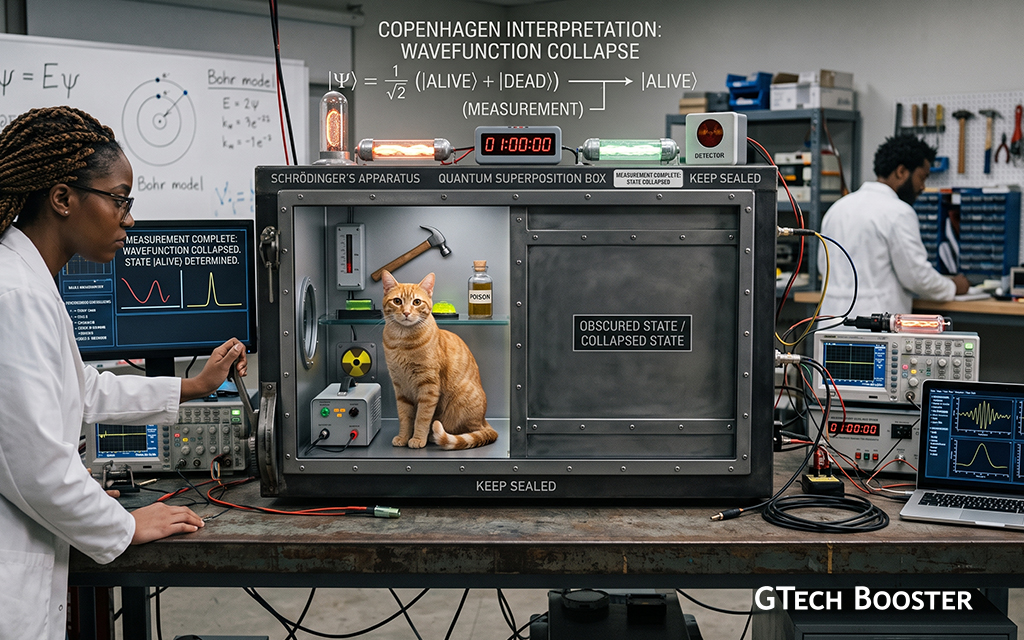
Nearly a century after it was first proposed, Schrödinger’s thought experiment remains a central point of reference in discussions about the nature of quantum reality. It highlights the fundamental disconnect between quantum mechanics and human observations of the macroscopic world. As practical research into quantum computing and quantum information systems continues to develop, this paradox serves as a foundational reminder of the non-intuitive rules that govern physics at the smallest scale
More Information ℹ


















Conversation
Login to comment.
Log In / Register