The Mpemba Effect – When Hot Water Freezes Faster Than Cold
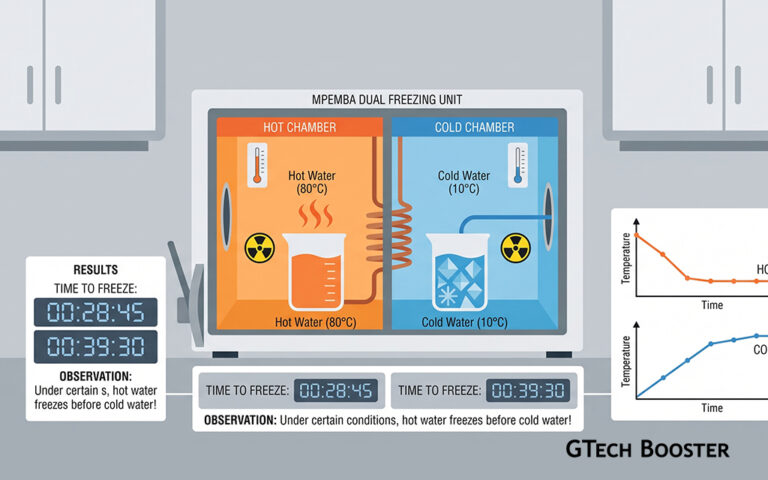
The Mpemba effect describes a genuinely counterintuitive observation: under certain conditions, hot water can freeze faster than cold water, even though the hot water has to pass through the exact same lower temperature the cold water started at on its way to freezing. It sounds like it should be impossible, and for a long time it was treated as a curious bit of kitchen folklore rather than serious science. That has changed considerably. This article covers the effect’s history, the leading scientific explanations for why it happens, the genuine scientific controversy over how real and how reproducible it actually is, and the surprising new direction the research has taken into quantum physics over just the past few years.
What the Effect Actually Describes
Stated simply, the Mpemba effect is the observation that, given two samples of water identical in every way except starting temperature, one hot and one cold, the hotter sample can sometimes freeze to ice before the colder one does, under otherwise matched cooling conditions. Intuition suggests this should never happen, since the hot sample must first cool down through the colder sample’s exact starting temperature before it can freeze, meaning it appears to have strictly further to go. The effect is considered “non-monotonic” specifically because whether hot water freezes first does not simply increase or decrease predictably as starting temperature changes, it can flip depending on the exact conditions of the experiment.
A Discovery With Deep Historical Roots
The effect’s modern name comes from Erasto Mpemba, who in 1963, as a secondary school student in Tanzania, noticed that a hot ice cream mixture he placed in a freezer froze faster than a colder mixture prepared by a classmate. Teachers initially dismissed his observation as implausible, but Mpemba persisted, and he eventually connected with physicist Denis Osborne during a visit to his school. Osborne took the claim seriously enough to test it experimentally, and the two published a joint paper on the phenomenon in 1969, giving the effect its modern name and its first real foothold in the scientific literature.
The Mpemba effectnoun
The Leading Proposed Explanations
Because the Mpemba effect can arise from several different physical mechanisms simultaneously, and because the exact experimental setup matters enormously, researchers have proposed a range of explanations over the decades, several of which likely contribute together rather than any single one fully accounting for every observed instance of the effect.
Evaporation
One of the more straightforward proposed mechanisms is evaporation. Hot water evaporates faster than cold water, and evaporation itself carries heat away from the remaining liquid while also reducing the total mass of water left to freeze. A smaller remaining volume of water requires less total heat removal to freeze completely, giving the hot sample a genuine, quantifiable head start under conditions where evaporation is allowed to occur freely, such as an open container.
Dissolved gas content
Cold water can hold more dissolved gas than hot water, and heating water drives dissolved gases like carbon dioxide out of solution. Some researchers have proposed that water with less dissolved gas may freeze more readily, potentially through effects on how the water’s molecular structure organizes as it approaches freezing, giving previously heated water an advantage once it cools back down to the same temperature as an untreated cold sample.
Convection and non-uniform cooling
Hot water sets up stronger convection currents within its container as it cools, circulating warmer water from the interior toward the surface where it can lose heat more efficiently, while colder water, having a smaller temperature difference with its surroundings to begin with, convects less vigorously. This can mean the hot sample cools somewhat more efficiently on average than a simple, uniform temperature model would predict, since convection continually brings warm interior liquid into contact with the cold container walls or air.
Supercooling differences
Water does not always freeze immediately upon reaching zero degrees Celsius, it can supercool, remaining liquid below its nominal freezing point until ice crystallization is finally triggered by a nucleation event. Some research has found that water which has previously been heated is less prone to supercooling than water that has not, meaning a previously hot sample may begin actual ice formation sooner after reaching freezing temperature than a cold sample that supercools further before crystallizing, even if the two samples reach zero degrees at a similar moment.
Hydrogen bond and molecular structure effects
More speculative research has proposed that heating water alters its hydrogen bonding network, and that these structural changes persist briefly even after the water cools back down, potentially affecting how readily the water can transition into ice. This remains one of the more contested proposed mechanisms, with some subsequent work questioning whether the effect is large enough, or persists reliably enough, to meaningfully explain the phenomenon on its own.
An Aftermath Scientific Controversy
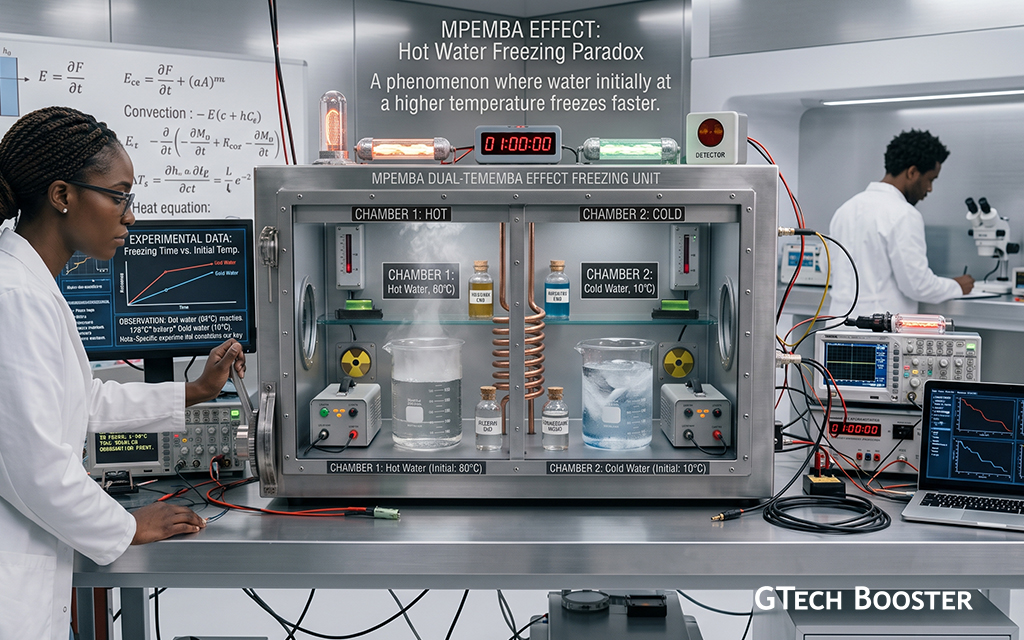
A particularly 2016 paper by James Burridge and Paul Linden at the University of Cambridge specifically went to challenged how reliably the effect could actually be reproduced under carefully controlled laboratory conditions, arguing that much of the historical evidence for the effect may have been confounded by inconsistent measurement methods, particularly around exactly where a thermometer was placed in the sample and precisely how “frozen” was defined for measurement purposes, both of which can dramatically affect results in water samples that are naturally cooling unevenly.
A widely read 2023 retrospective published in Skeptical Inquirer, titled “The Rise and Fall of the Mpemba Effect,” captured this more skeptical position directly, arguing that once measurement inconsistencies are properly controlled for, the classical hot-water-freezes-first result becomes considerably harder to reliably reproduce than popular science coverage of the phenomenon typically suggests. This does not mean researchers agree the effect is entirely illusory, more recent work, including a 2025 study specifically framing the phenomenon in pure water as having a stochastic, or probability-based, origin, has continued taking the underlying physics seriously while working to more precisely characterize exactly when and why it does or does not appear.
The honest scientific summary is that the classical water version of the Mpemba effect is real under specific, well-defined conditions as all experiments are, but it is highly sensitive to the exact experimental setup, and universally reproducible as the popular “hot water always freezes faster” framing implies.
The Surprising New Frontier: The Quantum Mpemba Effect
One of the more genuinely remarkable developments in this area over the past several years has been the discovery that a version of the Mpemba effect appears not just in ordinary water, but in the behavior of quantum systems themselves, an area of research that has grown rapidly since around 2023.
The quantum Mpemba effect describes situations where a quantum system that starts out further from equilibrium relaxes toward that equilibrium state faster than an equivalent system that started out closer to it, an even more counterintuitive echo of the same basic non-monotonic pattern seen in the original water experiments. Researchers have now demonstrated versions of this effect across a genuinely wide range of quantum platforms, including trapped ion qubits, dissipative quantum circuits, damped quantum harmonic oscillators, and even in measures of quantum complexity itself. A particularly striking 2024 demonstration used a single trapped ion qubit to show an “inverse” quantum Mpemba effect directly, while a 2025 Kyoto University study specifically characterized what researchers termed the “thermomajorization Mpemba effect,” describing the precise thermodynamic conditions under which this accelerated relaxation can occur in quantum systems generally.
This growing body of quantum research is not merely a cute mathematical curiosity borrowing a memorable name. Researchers studying it have pointed to genuine potential applications in improving the efficiency of heat engines and cooling technologies, and the underlying dynamics are considered directly relevant to ongoing work in quantum computing and biophysics, since faster, more predictable relaxation toward equilibrium is a genuinely useful property in several of these fields. This represents one of the more interesting recent examples of a phenomenon first noticed anecdotally in a school freezer becoming, decades later, a genuine and active area of fundamental physics research operating at a completely different scale.
Practical Considerations and Common Misunderstandings
A few points are worth clarifying given how often the classical version of this effect gets oversimplified in casual conversation.
It is not a claim that heat itself accelerates cooling in general. The effect depends heavily on specific conditions, including container shape, initial volume, the surrounding environment, and whether evaporation and convection are able to occur freely, rather than being a simple, universal rule that hot water always outpaces cold water to the freezer.
Multiple mechanisms likely combine rather than one single explanation accounting for every case. Evaporation, convection, dissolved gas content, and supercooling behavior can all plausibly contribute simultaneously in a real experimental setup, which is part of why isolating a single definitive cause has proven so difficult, and why different research groups studying different specific experimental conditions have sometimes reached different conclusions about which mechanism dominates.
Reproducibility genuinely depends on precise measurement methodology. The 2016 Cambridge critique specifically highlighted how sensitive the observed effect is to details like thermometer placement and the exact definition of “frozen,” meaning informal home freezer demonstrations are considerably less rigorous than they might appear, and inconsistent results between casual attempts to replicate the effect are not necessarily evidence against it, so much as evidence of how methodologically delicate the classical water experiment actually is.
Wrapping Up
The Mpemba effect sits in a genuinely interesting position within science: a phenomenon first noticed by ancient philosophers, rediscovered by a curious student, taken seriously enough by professional physicists to generate real, still-ongoing debate about its exact mechanisms and reliability, and then, decades later, unexpectedly reborn as a thriving area of quantum physics research entirely removed from the original freezer experiment that gave it its name. The classical water version remains scientifically contested in its details even today, with legitimate researchers disagreeing about how reproducible it truly is once measurement methodology is properly controlled for, while the quantum version has, somewhat remarkably, turned the same basic counterintuitive pattern, a system further from equilibrium settling faster than one closer to it, into a genuinely productive lens for understanding relaxation dynamics in physical systems far removed from anything Erasto Mpemba could have imagined watching his ice cream mixture freeze in a school kitchen freezer.
More Information ℹ


















Conversation
Login to comment.
Log In / Register