postmarketOS – Giving Old Smartphones a Real Linux Life Beyond Android
The single most important thing to understand about postmarketOS is what it is not. It is not a custom Android ROM like LineageOS, and it does not use the Android build system, the Android hardware abstraction layer, or any Android userspace components.
Most smartphones die long before their hardware actually fails. A phone that is perfectly capable of running smoothly gets abandoned by its manufacturer after two or three years of security updates, and from that point on it is effectively unsafe to keep using for anything sensitive, not because the chip wore out, but because the software stack around it stopped being maintained. postmarketOS is a project built directly around that problem. It is a real Linux distribution, not an Android skin or a modified Android build, designed to run on phones, tablets, and other ARM-based devices long after their original manufacturer has walked away from them.
This article looks at what postmarketOS actually is, how it works under the hood, what using it is really like today, and where the project is heading.
What postmarketOS Actually Is
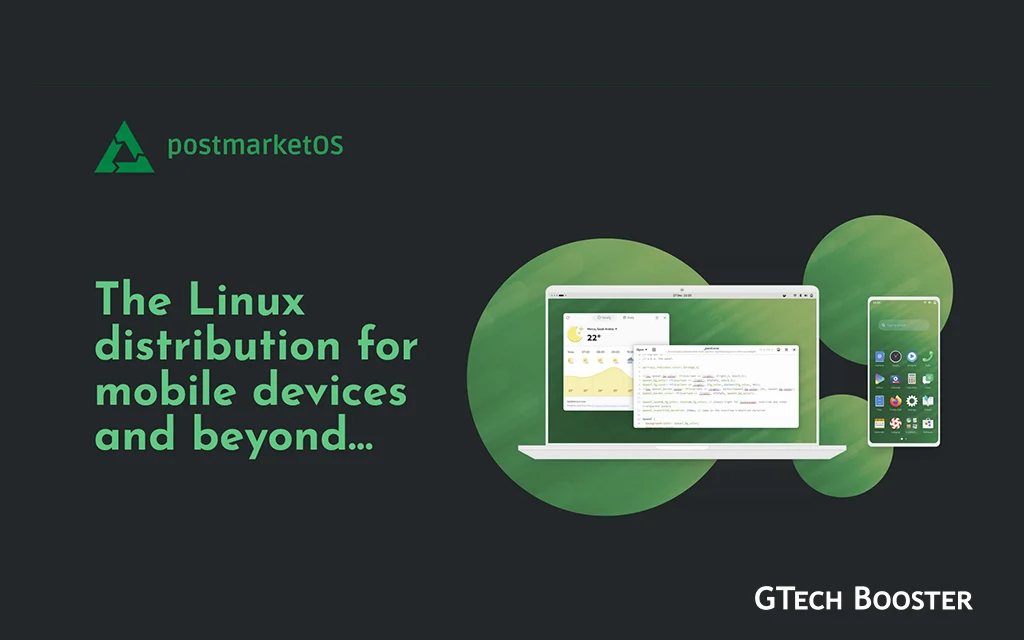
postmarketOS, usually abbreviated to pmOS, is a mobile operating system built on top of Alpine Linux, a small, security-oriented Linux distribution originally designed for servers and containers rather than phones. Alpine itself is built around musl libc and BusyBox rather than the glibc and GNU userland most desktop Linux distributions use, which keeps the base system unusually small and lean, a useful trait on hardware with limited storage and memory.
The single most important thing to understand about postmarketOS is what it is not. It is not a custom Android ROM like LineageOS, and it does not use the Android build system, the Android hardware abstraction layer, or any Android userspace components. When a device is running postmarketOS, Android is not present anywhere on it. This is a genuine, general-purpose Linux system running on a phone, with a real package manager, a real init system, and the same kind of software you would expect to find on a Linux laptop, adapted to a touchscreen form factor.
The project was started by Oliver Smith, who began development in 2016, with the first public release following on May 26, 2017. The motivation was straightforward: manufacturers routinely fork Android separately for each device, write custom kernels tied to that specific hardware, bundle proprietary drivers that only work with that one vendor stack, and then stop supporting the whole thing two or three years after the device launches, despite the hardware itself remaining perfectly functional with years of usable life left in it.
The Core Idea: Mainlining Instead of Forking
The technical strategy that sets postmarketOS apart from most other alternative mobile operating systems is its long-term commitment to mainlining. Rather than maintaining a permanently separate, heavily patched kernel fork for every single device forever, the project’s contributors work to get device support merged directly into the upstream Linux kernel itself wherever possible. When a driver or feature lands upstream, that code benefits every Linux distribution, not just postmarketOS, and it becomes something the wider kernel community helps maintain rather than something a single volunteer has to carry alone indefinitely.
This is slow, unglamorous work. Getting a touchscreen, a modem, a camera sensor, or power management working correctly on an upstream kernel for a phone that was never designed with mainline Linux in mind can take months of reverse engineering and patch submissions. The project’s own early history illustrates this well. Getting basic functionality working on early mainlined devices required solving problems one piece at a time, from USB and internal storage to accelerometer, gyroscope, barometer, and display support, each one a separate, often difficult reverse-engineering effort before the device was usable at all.
The payoff for this approach is durability. A device supported through a genuine mainline kernel port does not depend on a single vendor’s now-abandoned source tree. It can keep receiving kernel security updates for as long as the wider Linux kernel project supports that architecture, which in practice can be a decade or more, a dramatically different lifespan than the two to three years of updates a typical Android device gets from its manufacturer.
How Devices Are Supported: Tiers, Not a Single List
postmarketOS does not treat every supported device the same way, and understanding its tier system is important for setting realistic expectations. Devices are organized into categories reflecting how complete and reliable their support actually is, ranging from experimental community ports with missing features up through a “testing” tier for devices with more mature, dependable support. As of the mid-2026 release cycle, 254 devices sat in the testing category, alongside a much larger long tail of devices at earlier, more experimental stages of support. The project has been explicit that the very top tier, reserved for a device considered fully polished and production-ready as a daily driver, remains unfilled, work toward reaching that bar for at least one device is an ongoing and active goal rather than something already achieved.
The overall device count has grown enormously since the project’s early days, when getting a single phone to make phone calls at all was still an open problem. By February 2026, postmarketOS supported an estimated 723 device models in total across every tier, spanning Android phones and tablets from Samsung, Google, OnePlus, Xiaomi, Nokia, LG, Fairphone, and BQ, older Windows and Nokia Linux devices like Lumia phones and the Nokia N900 and N9, Pine64’s purpose-built Linux phones, several Chromebooks, generic x86_64 PCs, and even more unusual hardware. Support for the Fairphone 6, a device explicitly designed around repairability and longevity, was in progress as of mid-2025, a pairing that lines up naturally with postmarketOS’s own mission. Work has even extended to an early, limited port for the iPhone X, built on research from the Asahi Linux and Hoolock Linux projects, and to the Lynx R1, the project’s first supported VR headset.
Anyone considering postmarketOS for a specific device should check the project’s own wiki page for that exact model before committing, since the difference between a device with fully working calls, SMS, cameras, and cellular data and one that only boots to a desktop with broken Wi-Fi and no modem support can be enormous, even among devices that technically appear on the supported list.
What the Experience Actually Looks Like
Because postmarketOS is a genuine Linux distribution rather than a mobile-specific walled ecosystem, it supports several different graphical interfaces rather than locking users into one look and feel. The most commonly used options include Phosh, a GNOME-based mobile shell built specifically for touchscreen phones and originally developed for the Librem 5; Plasma Mobile, KDE’s touch-oriented mobile interface; a mobile GNOME session; and Sway, a keyboard-and-touch-friendly tiling window manager for users who want a more minimal, technical setup. There is also Sxmo, a highly minimal, keyboard and menu driven interface aimed at older or lower-powered hardware, and traditional desktop environments like MATE or XFCE4 for devices being repurposed away from phone use entirely, such as a small home file server or a dedicated single-purpose device connected to a keyboard and mouse over USB.
Package management runs through apk-tools, the same lightweight package manager Alpine Linux uses on servers, giving postmarketOS access to a genuinely large software repository shared with Alpine itself, alongside mobile-specific packages maintained by the postmarketOS community.
The practical day-to-day experience varies significantly by device and by how mature that device’s port is. On well-supported hardware, basic functions like calls, SMS, mobile data, Wi-Fi, and the display work reliably. On less mature ports, expect genuine rough edges: battery life that can be noticeably worse than the same hardware running Android, because the kernel port may not correctly support deep sleep power states yet, cameras that do not work at all, or a modem that requires manual configuration. postmarketOS is realistic about this itself, describing itself as functioning well today as a server, a kiosk device, or a privacy-focused secondary phone for users willing to accept these constraints, rather than universally promising a flawless daily driver experience on every supported device.
For users who need specific Android apps, particularly banking apps that rely on Google Play Services or hardware attestation, compatibility is limited. Some of these apps can be made to work through Waydroid, a container-based Android compatibility layer, sometimes paired with microG as a lightweight, privacy-respecting substitute for Google Play Services, but this varies significantly by app and is not something to count on for anything critical.
Recent Technical Direction
postmarketOS has continued to evolve significantly over the past couple of years rather than standing still. A major architectural shift was the project’s move to adopt systemd as its init system, a genuine change in direction given Alpine Linux’s traditional use of OpenRC. The reasoning was practical rather than ideological: the project’s own explanation was that getting KDE and GNOME software working well on postmarketOS required a growing pile of systemd compatibility shims layered on top of an OpenRC based system, and since Plasma Mobile, GNOME Mobile, and Phosh together make up the majority of actively used interfaces on postmarketOS, adopting systemd directly reduced that ongoing maintenance burden considerably.
The project has also been actively working toward replacing its historical model of maintaining a separate kernel build and patchset for every individual supported device with a smaller number of generic mainline kernel images that can boot across many devices at once, relying on device tree overlays and firmware packages to handle hardware-specific differences rather than a full custom kernel per phone. This directly addresses one of the project’s longest-standing scaling problems: under the old model, every new device meant another kernel for a volunteer to personally build, patch, and keep updated indefinitely, a workload that could not keep pace with a rapidly growing device list.
Alongside this, postmarketOS has been exploring an immutable, read-only system design, sometimes referred to internally as Duranium, conceptually similar to the approach used by projects like Fedora Silverblue or NixOS on the desktop. The goal is to make the system meaningfully more resistant to the kind of partial or interrupted update that can leave a mutable, traditionally-updated Linux system in a broken or unbootable state, which matters even more on a phone than on a desktop, since a bricked phone is a much bigger inconvenience than a bricked laptop sitting on a desk.
The project’s most recent major release as of mid-2026, version 26.06, nicknamed “Alpen Avocado” and built on Alpine Linux 3.24, shipped GNOME 50, switched from a custom boot splash to the widely used Plymouth boot animation system, added emergency cell broadcast alert support through an upgraded ModemManager, a first for Linux phones, and included sudo-rs security improvements, all while expanding the testing-tier device count to 254 devices.
Community, Governance, and Backing
postmarketOS remains a volunteer-driven, community-governed open source project rather than a corporate product, though it has picked up meaningful institutional support along the way. GNOME’s decision to join postmarketOS’s advisory board brought real organizational weight from an established Linux desktop project with deep institutional roots, reflecting a broader alignment between the mobile Linux movement and traditional desktop Linux communities, since GNOME’s own Phosh-adjacent mobile work and postmarketOS’s user base overlap substantially.
Development happens openly on the project’s GitLab instance, with device-specific packaging repositories, kernel patches, and documentation all publicly available for anyone willing to contribute, whether that means writing code, testing hardware, maintaining documentation, or simply reporting bugs on a device they own. The project also holds and participates in real-world community events, including its own postmarketOS and Alpine Linux Conference, alongside general open source events like FOSSY and FrOSCon, giving the mobile Linux community outside of any single company a recurring place to coordinate in person.
Financially, the project relies substantially on donations through OpenCollective rather than a single corporate backer, which shapes both its pace of development and its independence. Progress on any individual device port depends heavily on whether a specific volunteer maintainer is actively working on it, which is also why the project has repeatedly emphasized that devices without an active maintainer risk being moved out of more mature support tiers and eventually archived if nobody steps up to keep them working through kernel and userspace changes over time.
The Underlying Philosophy
postmarketOS describes its own long-term ambition as extending the usable security-supported lifespan of a smartphone to roughly ten years, a dramatic departure from the two to three years of official support most Android devices receive from their manufacturers before software updates stop entirely. The project’s own framing of its mission is less about being a slicker Android alternative and more about ownership: the idea that a device a person paid for should remain genuinely useful for as long as its hardware physically allows, that security updates should not be something a corporation can simply decide to stop providing on a schedule set by its own product cycle, and that open source software has no fundamental reason to become unusable just because a manufacturer moved on to selling a newer model.
This philosophy is reinforced by one of the project’s favorite recurring examples: the Nokia N900, a device now well over a decade old, continuing to receive functional postmarketOS updates alongside brand new hardware, a direct, ongoing demonstration that the ten-year lifespan goal is not just marketing language but something the project actively works toward with real, maintained hardware.
Who postmarketOS Is Actually For
It is worth being honest about who gets the most value out of this project today. postmarketOS is not currently positioned as a turnkey replacement for Android or iOS for someone who simply wants their everyday phone to work exactly the way it does now, just running different software. It is a strong fit for people who want to rescue an otherwise abandoned phone or tablet and turn it into something genuinely useful again, whether as a privacy-respecting secondary device, a small home server, a dedicated single-purpose gadget, or a platform for learning and tinkering with real Linux internals on mobile hardware. It is also a natural fit for anyone philosophically invested in software longevity, the right to repair movement, and reducing electronic waste, since every additional year a device stays usable through community-maintained software is a year that device does not end up discarded.
For someone who needs a fully dependable daily driver phone today, with flawless camera performance, full banking app compatibility, and zero rough edges, more polished alternatives built specifically for that goal, such as GrapheneOS on supported Pixel hardware, remain a more practical choice in the near term. postmarketOS’s own honesty about where it currently stands, acknowledging that even its best-supported devices sit in a “testing” tier rather than its intended top tier, is part of what makes it a credible, trustworthy project rather than an overpromising one.
Revealed
postmarketOS represents one of the more genuinely ambitious efforts in the mobile Linux space precisely because it refuses to take the easy shortcut of quietly forking Android and calling it independence. By insisting on real mainline kernel work, a real general-purpose Linux userland, and a governance model built around community maintainers rather than a single corporate roadmap, the project has slowly built something that treats a phone the same way the Linux world has always treated a PC: as hardware that deserves to be supported for as long as it physically works, not for as long as its original seller finds it commercially convenient to keep updating. The rough edges are real and the project is upfront about them, but the underlying argument, that your hardware should outlive your manufacturer’s interest in it, is one that keeps proving itself true one more year with every old device that boots up running current software that a company somewhere has already decided to stop supporting.
More Information ℹ





Conversation
Login to comment.
Log In / Register