Understanding Streaming vs Downloading – Progressive vs Adaptive Explained
Only once the transfer finishes, or at least reaches a usable point, can that file be opened and used, and from that moment onward it exists independently on the device, accessible even without an internet connection.
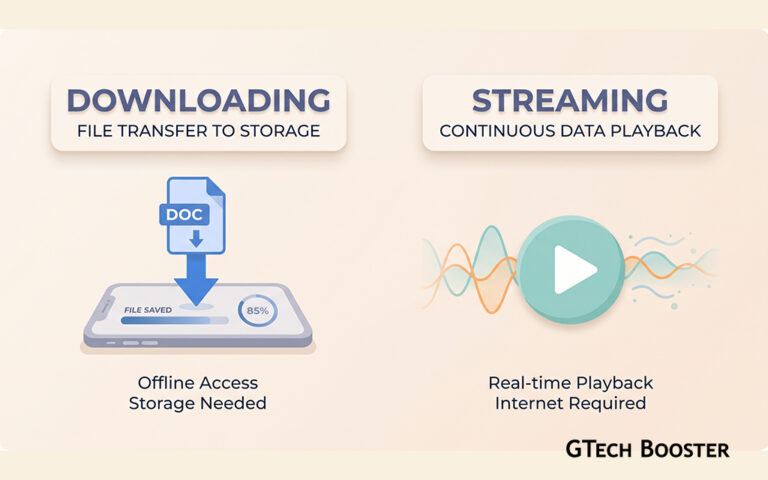
Downloading is the process of copying an entire file from a remote server onto a local device before it can be used. When a person downloads a song, a video, or a document, the complete file travels across the internet and is saved directly onto their phone, computer, or storage device. Only once the transfer finishes, or at least reaches a usable point, can that file be opened and used, and from that moment onward it exists independently on the device, accessible even without an internet connection.
This means downloading trades convenience at the start for convenience later. A person has to wait, sometimes for a long time depending on file size and connection speed, before they can use what they downloaded, but afterward the file is theirs to access offline whenever they like, without needing to reconnect to the original source.
How a Download Works
When a download begins, the device requests a file from a server, and the server sends that file across the network as a continuous stream of data packets. The device receives these packets and writes them to storage, piece by piece, until the entire file has arrived. Most modern download systems also track progress, allowing a person to see a percentage or progress bar indicating how much of the file has arrived so far, and many can resume an interrupted download rather than starting over from the beginning.
What Is Streaming?
Streaming is the process of playing audio or video content while it is still being received from a server, rather than waiting for the entire file to arrive first. Instead of storing a permanent copy on the device, a streaming service sends small pieces of content continuously, and the device plays each piece almost immediately after it arrives, creating the experience of watching or listening in real time.
This is the technology behind services people use every day, including video platforms, music streaming apps, and live broadcasts. Streaming generally does not leave a full, permanent copy of the content on the device once viewing ends, though a small amount is temporarily stored in memory, known as a buffer, to smooth out minor interruptions in the incoming data.
The Role of Buffering
Because streaming relies on a continuous flow of data arriving just in time to be played, a short buffer is used to store a few seconds of upcoming content in advance. This buffer acts as a cushion, absorbing brief slowdowns in the network connection without interrupting playback. If the network becomes too slow and the buffer runs out faster than new data arrives, playback pauses momentarily while the device waits for more content to catch up, an experience most people recognize as buffering.
Streaming vs Downloading: The Core Difference
The fundamental distinction between streaming and downloading comes down to timing and storage. Downloading requires the complete file, or a very large portion of it, to arrive before it becomes usable, and it results in a permanent copy saved on the device. Streaming allows content to be consumed while it continues arriving, and it typically does not leave a lasting copy behind once the session ends.
This difference leads to different practical trade offs. Downloading is well suited to situations where offline access matters, such as loading a movie before a flight with no internet access, or where a file needs to be used repeatedly without depending on a network connection each time. Streaming is better suited to situations involving very large libraries of content, live events, or anywhere storing every piece of content permanently would be impractical or unnecessary, since a streaming service can offer access to enormous catalogs without requiring users to have enough storage space for all of it.
Two Approaches to Streaming: Progressive and Adaptive
Streaming itself is not a single, uniform technology. Two major approaches have shaped how streaming works over the years, known as progressive streaming and adaptive streaming, and understanding the difference between them explains why some video experiences feel far smoother than others.
Progressive Streaming
Progressive streaming, sometimes called progressive download, is an earlier and simpler approach. In this method, a video file is delivered from the server to the device as a single, continuous stream at one fixed quality level, decided before playback even begins. As the video downloads, the player is able to begin playing the portions that have already arrived, giving the appearance of streaming, even though what is really happening is closer to downloading a file while simultaneously watching the beginning of it.
Because progressive streaming delivers content at one predetermined quality regardless of a person’s current network conditions, it does not adjust well when a connection slows down partway through playback. If someone’s internet speed drops while watching a progressively streamed video, the buffer can run out, causing playback to pause and wait, since there is no mechanism to automatically switch to a lower quality version that requires less data.
Adaptive Streaming
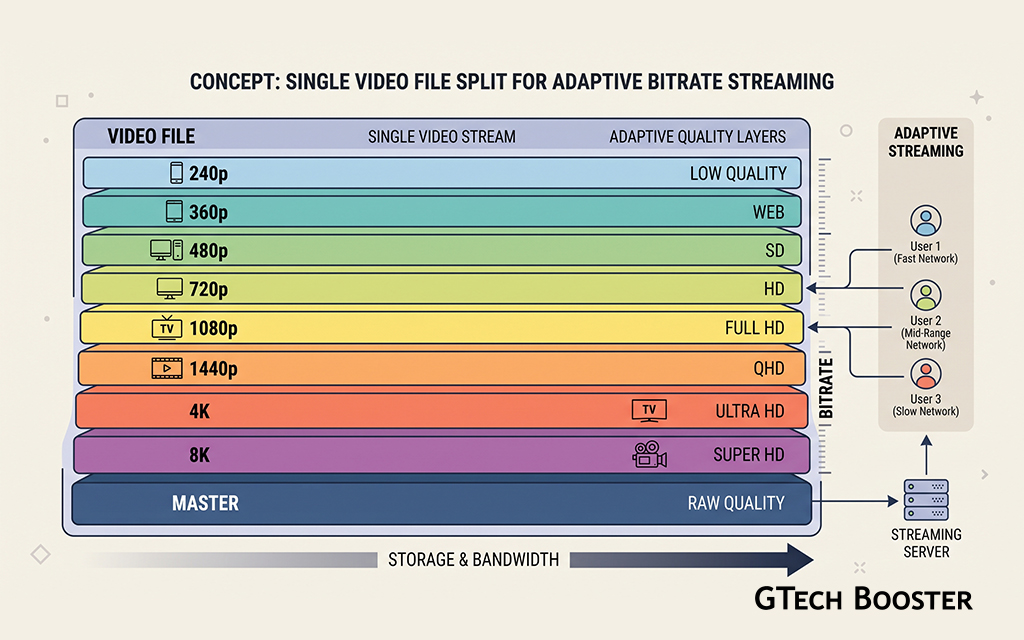
Adaptive streaming, more formally known as adaptive bitrate streaming, was developed to solve exactly this limitation. Instead of offering a video at only one fixed quality, an adaptive streaming system prepares multiple versions of the same content, each encoded at a different quality level and file size, ranging from lower resolution versions that require less data to higher resolution versions that require significantly more.
As a video plays, the streaming player continuously monitors the viewer’s current network speed and device performance. If the connection is fast and stable, the player requests higher quality segments, providing sharper picture and sound. If the connection slows down, the player automatically switches to a lower quality version for the next few seconds of video, reducing the amount of data needed and helping prevent the playback from pausing to buffer. This switching happens in small segments, typically just a few seconds of video at a time, allowing the system to react quickly to changing network conditions throughout playback.
Comparing the Two Approaches
The practical difference between progressive and adaptive streaming becomes most apparent when network conditions are inconsistent. With progressive streaming, a person on an unstable connection is likely to experience frequent pausing and buffering, since the video quality cannot adjust downward to compensate for a slower connection. With adaptive streaming, that same person is far more likely to experience uninterrupted playback, because the system quietly reduces quality behind the scenes rather than letting the video stall completely.
This is why nearly all major modern streaming platforms, including popular video and live streaming services, rely on adaptive streaming technology today. It allows a single piece of content to be delivered smoothly to an enormous range of devices and network conditions, from a fast home internet connection to a fluctuating mobile data signal, without requiring separate manual quality settings from the viewer in most cases.
Bringing It All Together
Downloading and streaming represent two different philosophies for delivering digital content. Downloading transfers a complete file onto a device before use, trading an upfront wait for reliable offline access afterward. Streaming delivers content continuously as it plays, avoiding the need for a full file to be stored while depending on a steady enough network connection to avoid interruptions.
Within streaming itself, progressive streaming represents an earlier, simpler method that delivers content at a single fixed quality, leaving it vulnerable to buffering when network conditions change. Adaptive streaming solves this by preparing multiple quality versions of the same content and dynamically switching between them based on real time network conditions, resulting in a far smoother viewing experience across a wide range of situations.
Understanding these distinctions clarifies why a downloaded movie plays perfectly on an airplane with no internet at all, why a livestream sometimes shifts noticeably in picture quality without stopping entirely, and why older or simpler streaming setups are far more prone to frustrating pauses than the adaptive systems used by most major platforms today.
More Information ℹ


















Conversation
Login to comment.
Log In / Register