Ending the monopoly – Why Ghana is betting $600 million on an AT-Telecel alliance
The government currently owns 100% of AT Ghana and holds a 30% stake in Telecel Ghana. The plan involves swapping the government's AT equity for additional shares in Telecel. After the GHC 1 situation.
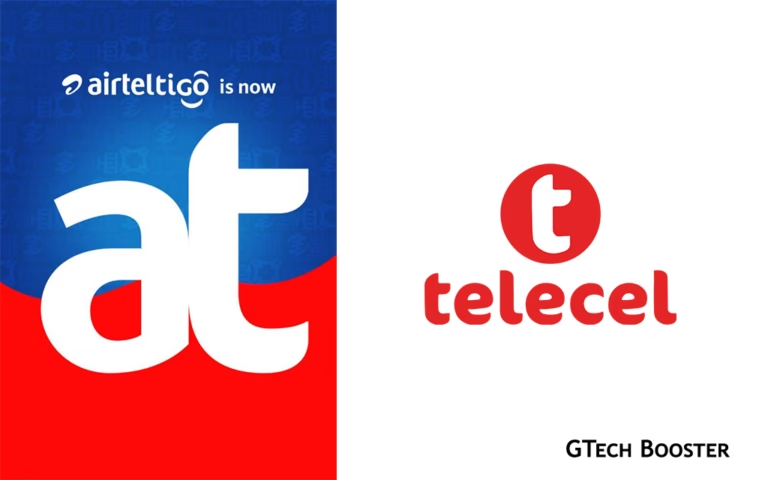
For over a decade, Ghana’s telecommunications landscape has been a lopsided battlefield. As of early 2026, the government has officially triggered a high-stakes intervention: the integration of AT (formerly AirtelTigo) and Telecel Ghana. This is no ordinary merger, it is a $600 million state-backed gamble to prevent a market collapse and challenge the undisputed dominance of MTN.
The Rescue Mission
The move was born out of necessity. In 2025, AT Ghana was on the brink of a total blackout, recording over $10 million in losses in just eight months and drowning in nearly $289 million of debt to tower providers. The Minister for Communication, Digital Technology and Innovations, Hon. Samuel Nartey George, was blunt about the situation when he is quoted as saying:
“Taxpayer money that should be building roads and schools cannot keep pouring into unsustainable operations.”
Minister for Communication, Digital Technology and Innovations, Hon. Samuel Nartey George
By merging AT with Telecel (where the government already holds a 30% stake), the state aims to stop the bleeding and protect the interests of 3.2 million AT subscribers. The government has projected a need for $600 million over the next four years, with contributions expected from spectrum sales, Telecel itself, and other strategic partners. This investment is intended to fund 5G trials, rural network expansion, and modernization of the mobile money platform.
The reason behind the second force strategy
The primary goal of this alliance is to create a functional duopoly. For years, MTN has held a Significant Market Power (SMP) status, controlling over 70% of the market since after poor governance amid bad longterm planing saw to the aquisition of then Spacefon by Areeba which even as locals had qualified bids; fell in the hands of MTN at the time. Much as MTN has undoubtedly undertaken some innovations in the industry quality of service is very poor and only laud itself by stacking itself with poor performance from the current competition even as it charges most of the highest fees in the industry and has the higher subscriber base currently. Aside that capital flight out of the country due to it being foreign controlled is a huge issue; something the Bank of Ghana is taking step to curb.
The combined entity, estimated to command 11 million subscribers will finally give Ghana a viable second force.
Why Is Ghana Doing This?
MTN’s Overwhelming Dominance
Prior to the merger, MTN Ghana commanded nearly 74% of the market with 29.5 million subscribers, while Telecel had 7.2 million and AT 3.2 million. Ghana’s policymakers consider this level of concentration unhealthy for consumers and the broader digital economy.
AT Ghana Is Financially Collapsing
AT Ghana has racked up more than $10 million in losses within just eight months, with the state forced to bail it out. As the Communications Minister put it: “These losses are funded by taxpayers. That is money that should be building roads, water systems, and schools.”
Infrastructure Crisis Forced the Government’s Hand
The takeover became unavoidable after American Tower Corporation began deactivating AT’s cell sites on the 1st of September over roughly $150 million in unpaid bills. Ghana’s total liabilities have since risen to $289 million. The government had to act fast to prevent millions of subscribers from losing service entirely.
Past Mergers Failed to Work
This is not Ghana’s first attempt at telecom consolidation. Airtel and Tigo previously merged in 2017, but the unified company failed to gain ground against MTN. AirtelTigo’s market share declined sharply from 25.82% in 2018 to 7.89% by the end of 2024. As was evidence in what traspired; it managers wanted the outcome that eventually became. This time, the government is backing the effort with significant capital to ensure it sticks.
What a Merged Entity Looks Like
Post-merger, the new Telecel-AT entity will control more than 10 million subscribers, giving it roughly 26% market share a stronger second force against MTN’s dominance. The government currently owns 100% of AT Ghana and holds a 30% stake in Telecel Ghana. The plan involves swapping the government’s AT equity for additional shares in Telecel. After the GHC 1 situation.
Key Risks and Hurdles
The National Communications Authority must first waive its 55 MHz spectrum cap to allow Telecel to acquire AT’s frequency blocks. MTN strongly advocates for an open auction rather than a direct handover, arguing a direct transfer would create an unfair advantage
If the deal secures funding and regulatory approval, Ghana’s mobile market will transition from a quasi-monopoly to a functional duopoly. If it fails, the problem of three million disconnected subscribers and nearly $300 million in debt will fall squarely back on the taxpayer.
The ICC Arbitration: The Real Spark Behind Everything
The ruling was handed down by the International Chamber of Commerce (ICC) International Court of Arbitration — one of the world’s most authoritative commercial dispute forums. It caps off a saga of debt, political maneuvering, and near-total network collapse that rattled Ghana’s telecom sector for years.
The plaintiff
American Tower Corporation Ghana (ATC Ghana) — the tower company that owns and operates the mast infrastructure AT Ghana depended on.
The defendant
AT Ghana (formerly AirtelTigo) — which had been systematically failing to pay its tower fees for years.
How the Debt Built Up
By the time Communications Minister Samuel Nartey George addressed Parliament in March 2025, the figure owed to ATC alone had reached GH¢1.5 billion, a portion of a total debt load on AT Ghana’s books that the minister put at over GH¢3.5 billion, equivalent to approximately US$225 million at prevailing exchange rates.
The Asset Stripping That Triggered the Lawsuit
This is the most damning part. What actually pushed ATC Ghana to file the ICC case was not just the unpaid bills — it was a legal sleight of hand by the departing government. Before leaving office, officials created a new entity called People’s Network (PPL Net) and transferred AT Ghana’s staff and assets into it. The stated goal was to protect jobs and attract investors by creating a clean-slate company free of legacy liabilities. AT Ghana’s debts, including what was owed to ATC, were left sitting with the old Airtel Ghana structure. The problem: ATC’s contracts were with AT Ghana, not PPL Net.
So ATC went to court. In January 2025, the Commercial Division of the High Court in Accra granted ATC an interim injunction preventing Airtel Ghana from transferring or disposing of its assets, pending the conclusion of the ICC arbitration. Justice Sheila Minta ruled the order necessary to preserve the integrity of the arbitration and ensure any award could be enforced.
The injunction came too late, the transfer of assets to PPL Net had already been done in November 2024.
ATC’s Extremely Generous Offer — Ignored
ATC reportedly offered to forgive all accumulated interest and slash the principal by about 80%, reducing the bill to approximately US$20 million. Even that offer went unanswered. No payment was ever made.
The Nuclear Option: Switching Off the Towers
With no resolution in sight, ATC Ghana moved from courtroom to field. On September 1, 2025, it began cutting power to AT Ghana’s radio access network sites — the physical towers that carry signal to subscribers. The immediate effect was catastrophic for a customer base of more than three million people.
That act of switching off the towers is what directly forced the government’s hand, the Telecel roaming arrangement, the KPMG audit, and ultimately the merger announcement all flowed directly from that moment.
Why This Changes the Story’s Framing
Without the ICC case, the $600 million Telecel–AT alliance looks like a strategic policy choice to counter MTN. With it, the picture is more complicated — it was largely a crisis response to:
Years of unpaid debt and financial mismanagement
- A controversial asset-stripping maneuver by the previous government
- A tower company that won in international court and then literally turned off the lights
- 3.2 million subscribers suddenly at risk of losing service
The opposition (Minority in Parliament) has also raised red flags, pointing out that Telecel had earlier promised $500 million in investment after acquiring Vodafone Ghana but failed to deliver, and that Telecel itself was already carrying about $400 million in debt; pointing at their fear of the same pattern repeating.
As of the 15th of April, 2026, AT has sent information to subscribers, informing them of the possibilities of experiencing difficulties accessing some of their service.
Dear Customer, You may experience difficulties accessing some of our services. Our team is working tirelesly to resolve the issue. We appologize for the inconvenience.
AT
Beneath this message is/are problems of varied proportions. As they are promising to working tirelessly to resolving the issues – good wishes are in accordance considering the temerity of the situation they find themselves.
Ghana is essentially making a high-stakes policy gamble: instead of letting AT Ghana collapse and leaving 3.2 million subscribers stranded while absorbing nearly $300 million in debt, the government betting at consolidation with Telecel; backed by $600 million in fresh investment can finally create a credible rival to MTN and deliver better quality of service, accelerate innovation, reduce unnecessary high prices and increase coverage for Ghanaians and sky rocket upward growth of the Ghana economy.
More Information ℹ







Conversation
Login to comment.
Log In / Register