
Linguistic Liberation: How Africa is Shaping LLMs and ML
Unwise plagued bureaucratic hierarchies slow decision-making, with limited integration of young innovators into AU processes, leading to inefficient adoption of local digital solutions over imported ones.

Africans hosts over 2,000 languages, yet most LLMs prioritize high-resource tongues like English, leaving 98% of African languages unsupported. A deliberate attempt at entrenchment of colonisation in the disguise of dominant language of choice. If this were not the case there should be a deliberate integration of local ones to deliberately replace the foreign tongue twitch; a byproduct of a situation that is always referred to as unfortunate event of a time. Yet even voice assistants like Google Home, Alexa, Bixby, Echo, Siri are all caught in this conundrum even though local pages of Google offer alternative to local languages with much limitation.

Initiatives like Lelapa AI’s InkubaLM target low-resource languages such as Swahili, Yoruba, isiXhosa, Hausa, and isiZulu, enabling translation and transcription to preserve cultural heritage. Such efforts counter tokenization biases and script neglect—only Latin, Arabic, and Ge’ez scripts receive attention amid 20 active ones. The resources of the continent fan the basis of all the tech productions yet the least of quality is made accessible there; Food for thought.
Local Innovations Rising
Contents
African developers build compact models like AfriBERTa (10M parameters) for tasks like question answering, contrasting resource-heavy giants like LLaMA 3 (405B). In South Africa, machine learning thrives in language processing, medical imaging, and astronomy, while startups address agriculture and healthcare. Projects decolonize AI by embedding ethnographic frameworks, ensuring outputs reflect Africa’s social and linguistic diversity rather than Western biases.
Challenges and Barriers
The digital divide limits access, with poor infrastructure, scarce data, and high compute costs hindering full-scale LLMs. Biases in global models amplify inequities, as training data overlooks African contexts, risking unfair health or policy applications. Community-driven corpus building and adaptation methods offer paths forward, but funding and talent gaps persist.
Pathways to Inclusion
Strategies include promoting indigenous startups for sector-specific AI in education and farming. Open-access models like InkubaLM foster linguistic equality, while regional datasets combat biases. By leveraging Africa’s diversity as a “testing ground,” the continent can reshape global AI toward equity.

Which African startups are developing local language models and tools
Several African startups lead efforts in developing local language models and tools, addressing the continent’s linguistic diversity with AI tailored to underrepresented languages. These initiatives focus on low-resource languages, cultural nuances, and practical applications like translation and speech recognition.
Startups in a direction
Lelapa AI (South Africa)
The build InkubaLM, a compact multilingual model for Swahili, Yoruba, isiXhosa, Hausa, and isiZulu, plus tools like Vulavula for voice-to-text in South African languages.
EqualyzAI (Nigeria)
They develop small language models and AI agents for native African speakers, emphasizing cultural context beyond basic translation.
CDIAL (Nigeria/USA)
Offers Indigenius Mobile for conversational AI across 180+ African languages, including smart keyboards and enterprise APIs for speech recognition.
Vambo AI (South Africa)
Provides a multilingual platform supporting 44 African languages with translation, transcription, and accessibility services.
Notable Others
Lesan AI (Ethiopia/Germany)
Creates translation tools for Amharic and Tigrinya to combat misinformation and enhance education access.
Masakhane (Pan-African)
Grassroots collective developing NLP models for Swahili, Yoruba, Zulu, and more, influencing tools like those from VulaAI.

These startups tackle data scarcity and biases through community-sourced datasets, fostering inclusion despite funding hurdles.
The Menace that needs a deliberate conscience
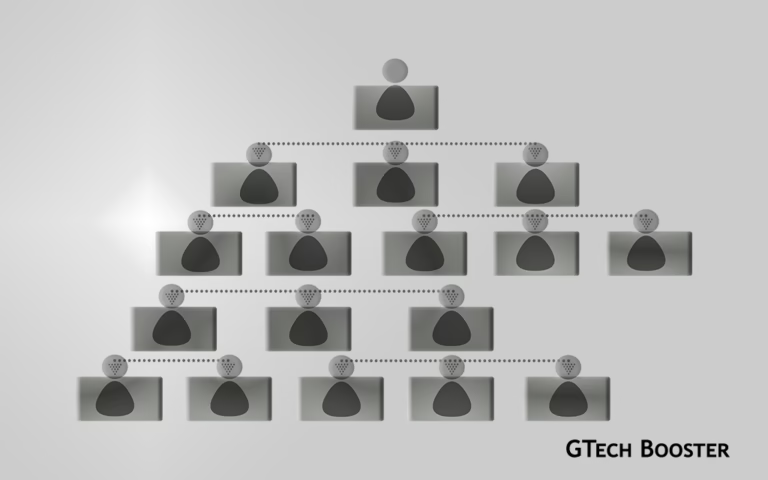
The continental body of Africans; African Union’s shortcomings in fostering continental innovation stem from fragmented leadership, inadequate funding mechanisms, and weak bridges between public policy and private ecosystems, perpetuating reliance on foreign tech.
Unwise plagued bureaucratic hierarchies slow decision-making, with limited integration of young innovators into AU processes, leading to inefficient adoption of local digital solutions over imported ones. Complex approval chains and poor onboarding hinder ownership, resulting in unsustainable projects that favor external consultants unfamiliar with African contexts.
Funding and Infrastructure Gaps
Chronic underfunding of R&I leaves Africa dependent on external partnerships, as seen in the AU-EU Innovation Agenda, which highlights needs for enhanced manufacturing capacity and anti-brain-drain measures. Infrastructure deficits, including research facilities and digital networks, stall STISA-2034 goals despite strategies like digital education upgrades.
Policy and Ecosystem Disconnects
The AU’s digital strategy overlooks geopolitical dependencies and fails to systematically link its 300+ innovation hubs to public sector needs, treating digitalization as economic without political leadership to reduce foreign reliance. This neglects valorizing local R&I, exacerbating talent flight and low private investment in homegrown tech.
The Inexhaustive remedy
Strengthening university-industry links across African states requires targeted strategies to bridge research, skills gaps, and market needs amid infrastructure and funding challenges.
Build Global Partnerships
African universities should pursue international collaborations to supplement local industry limitations, such as partnering with global firms for funding and expertise in R&D. Examples include World Bank-facilitated sessions linking Japanese companies with African institutions, yielding 12 partnerships by 2021.
Create Formal Platforms
Establish joint forums, conferences, and exhibitions where academia and industry co-present research, facilitated by professional bodies with dual memberships. Projects like SHESRA demonstrate success through university-industry case studies and stakeholder mapping to enhance outreach.
Clarify Expectations
Develop MoUs with specific deliverables, timelines, and metrics to ensure partnerships yield tangible innovations rather than vague agreements. Align curricula with labor markets via initiatives like Senegal’s REIS network for practical skills training.
Equip Institutions
Build the continents own access to tools better than the likes of SciVal for identifying industry partners via publications and patents, expanding low-cost programs with deliberate benefitable outputs. Strengthen IP protection to attract investments, building investor confidence in commercialisation.
Foster Regional Networks
Leverage AU frameworks and intra-African programs like USHEPiA for cross-border exchanges, while incentivizing private-public investments in research hubs.
The sub continental bodies must feed into the Continental body and the rots of the past must stay in the past as we forge ahead with purpose. The artificial lack no longer holds.
More Information ℹ

Gabby
















Be polite and constructive with your point.